Gender pay gap
Gender pay gap is the average difference between the remuneration for men and women who are working. Women are generally paid less than men. There are two distinct numbers regarding the pay gap: unadjusted versus adjusted pay gap. The latter takes into account differences in hours worked, occupations chosen, education and job experience. For the same work, pay gaps are less common. In some cases, women are paid more than men for the same job, due to the Equal Pay Act of 1963.
Causes[edit]
The causes of the gender pay gap are various and complex. They include both individual and societal factors, such as educational choices, work experience, occupation, industry, and region. Other factors include discrimination, gender stereotypes, and societal expectations.
Education[edit]
Education is a significant factor in the gender pay gap. Women tend to be overrepresented in fields that pay less, such as education and social work, while men are more likely to be in higher-paying fields such as engineering and computer science.
Discrimination[edit]
Discrimination is another factor contributing to the gender pay gap. This can take the form of direct discrimination, where women are paid less than men for the same work, or indirect discrimination, where women are disadvantaged by policies or practices that appear neutral but have a discriminatory effect.
Societal Expectations[edit]
Societal expectations and gender roles also play a role in the gender pay gap. Women are often expected to take on a larger share of domestic work and childcare, which can limit their career progression and earning potential.
Effects[edit]
The gender pay gap has significant effects on women's economic security and wellbeing. It contributes to women's lower lifetime earnings, lower pensions, and higher risk of poverty in old age. It also has wider societal effects, including on children's wellbeing and economic growth.
Solutions[edit]
Solutions to the gender pay gap include promoting equal pay for equal work, addressing occupational segregation, improving work-life balance, and tackling discrimination and gender stereotypes.
See also[edit]
 | This economics-related article is a stub. You can help WikiMD by expanding the page. |
 | This sociology-related article is a stub. You can help WikiMD by expanding the page. |
Gender_pay_gap[edit]
-
 US women's earnings as a percentage of men's 1979-2005
 -
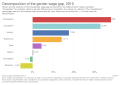 Decomposition of the gender wage gap, OWID
 -
 US women's earnings and employment by industry 2009
 -
 Cannes 2018
 -
 Gender wage gap
 -
 SOWM2010 female earned income ratio
 -
 EU 27 Gender Pay Gap 2014


Medical Disclaimer: WikiMD is for informational purposes only and is not a substitute for professional medical advice. Content may be inaccurate or outdated and should not be used for diagnosis or treatment. Always consult your healthcare provider for medical decisions. Verify information with trusted sources such as CDC.gov and NIH.gov. By using this site, you agree that WikiMD is not liable for any outcomes related to its content. See full disclaimer.
Credits:Most images are courtesy of Wikimedia commons, and templates, categories Wikipedia, licensed under CC BY SA or similar.
Translate this page: - East Asian
中文,
日本,
한국어,
South Asian
हिन्दी,
தமிழ்,
తెలుగు,
Urdu,
ಕನ್ನಡ,
Southeast Asian
Indonesian,
Vietnamese,
Thai,
မြန်မာဘာသာ,
বাংলা
European
español,
Deutsch,
français,
Greek,
português do Brasil,
polski,
română,
русский,
Nederlands,
norsk,
svenska,
suomi,
Italian
Middle Eastern & African
عربى,
Turkish,
Persian,
Hebrew,
Afrikaans,
isiZulu,
Kiswahili,
Other
Bulgarian,
Hungarian,
Czech,
Swedish,
മലയാളം,
मराठी,
ਪੰਜਾਬੀ,
ગુજરાતી,
Portuguese,
Ukrainian
