Fumaria officinalis
Fumaria officinalis, commonly known as Common Fumitory, Drug Fumitory or Earth Smoke, is a herbaceous annual flowering plant in the poppy family Papaveraceae. It is native to Europe and Western Asia and is naturalized in parts of North America, Australia, and New Zealand.
Description[edit]
Fumaria officinalis grows up to 10-50 cm tall, and is commonly found in hedgerows and fields. The leaves are finely divided and are arranged in a spiral around the stem. The flowers are pink to purplish, with darker tips, and bloom from April to October.
Distribution and Habitat[edit]
Fumaria officinalis is native to Europe and Western Asia. It has been introduced to other parts of the world, including North America, Australia, and New Zealand. It prefers disturbed habitats, such as fields, roadsides, and waste places.
Uses[edit]
Fumaria officinalis has been used in traditional medicine for its purported health benefits. It has been used as a treatment for skin diseases, digestive problems, and as a diuretic. However, there is limited scientific evidence to support these uses.
Toxicity[edit]
While Fumaria officinalis is generally considered safe for consumption, it can be toxic in large amounts. Symptoms of toxicity can include stomach upset, diarrhea, and skin irritation.
Cultivation[edit]
Fumaria officinalis is a hardy plant that can grow in a variety of soil types, including sandy, loamy, and clay soils. It prefers well-drained soil and can grow in both full sun and partial shade.
References[edit]

This flora-related article is a stub. You can help WikiMD by expanding it.
 | This medical article is a stub. You can help WikiMD by expanding the page. |
-
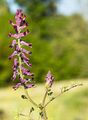 Fumaria officinalis habit
 -
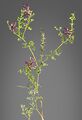 Fumaria officinalis plant habit
 -
Storage jar used for Fumitory Water, Italy, 1640-1660
-
 Protopine structural formula
 -
Fumaria officinalis illustration
_Fumaria_officinalis_-_Habit.jpg)
_Fumaria_officinalis_-_Plant_habit.jpg)

Advertise on WikiMD — 81,000+ full articles, ~900,000 total pages, ~250 million page views. Global reach, limited time promotional rates from $1/page/day. Learn more · View stats

Translate page: - East Asian
中文,
日本,
한국어,
South Asian
हिन्दी,
தமிழ்,
తెలుగు,
Urdu,
ಕನ್ನಡ,
Southeast Asian
Indonesian,
Vietnamese,
Thai,
မြန်မာဘာသာ,
বাংলা
European
español,
Deutsch,
français,
Greek,
português do Brasil,
polski,
română,
русский,
Nederlands,
norsk,
svenska,
suomi,
Italian
Middle Eastern & African
عربى,
Turkish,
Persian,
Hebrew,
Afrikaans,
isiZulu,
Kiswahili,
Other
Bulgarian,
Hungarian,
Czech,
Swedish,
മലയാളം,
मराठी,
ਪੰਜਾਬੀ,
ગુજરાતી,
Portuguese,
Ukrainian
About WikiMD • Contact • Disclaimer • Privacy • Copyright • Site statistics
Some content and images may originate from Wikimedia Commons or Wikipedia and remain subject to their stated licenses. Unless otherwise noted, eligible WikiMD content is available under CC BY-SA 4.0.
WikiMD Wellnesspedia — Free health & wellness information for patients, students, and health professionals.


