Fish cracker
Fish cracker is a popular snack food, often associated with various Asian cuisines, but also found in other parts of the world. It is typically made from fish or other seafood, flour, and various seasonings, then deep-fried until crispy.
History[edit]
The exact origins of the fish cracker are unclear, but it is believed to have originated in Southeast Asia, where fish is a staple food. It is a common snack in countries such as Indonesia, Malaysia, and the Philippines, where it is known as keropok, kerupuk, or kropek respectively.
Preparation[edit]
Fish crackers are typically made from a paste of ground fish or other seafood, mixed with tapioca flour and water. This mixture is then seasoned with salt, sugar, and sometimes other flavorings such as chili or garlic. The paste is rolled out into thin sheets, cut into shapes, and then deep-fried until they puff up and become crispy.
Varieties[edit]
There are many different varieties of fish crackers, depending on the type of fish or seafood used, the seasonings added, and the method of preparation. Some popular varieties include:
- Prawn crackers: Made from shrimp or prawns, these are a popular snack in many Asian countries, as well as in the Netherlands due to its historical ties with Indonesia.
- Crab crackers: Made from crab meat, these are a specialty of some coastal regions.
- Squid crackers: Made from squid, these are a popular snack in countries such as Japan and Korea.
Serving[edit]
Fish crackers are often served as a snack on their own, or as a side dish with meals. They can also be used as a topping for dishes such as noodle soups or salads, adding a crunchy texture.
See also[edit]

Fish_cracker[edit]
-
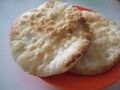 Kemplang fish cracker from Bandar Lampung
 -
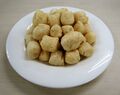 Amplang on a plate
 -
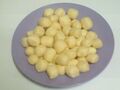 Amplang from Sabah, Malaysia


Medical Disclaimer: WikiMD is for informational purposes only and is not a substitute for professional medical advice. Content may be inaccurate or outdated and should not be used for diagnosis or treatment. Always consult your healthcare provider for medical decisions. Verify information with trusted sources such as CDC.gov and NIH.gov. By using this site, you agree that WikiMD is not liable for any outcomes related to its content. See full disclaimer.
Credits:Most images are courtesy of Wikimedia commons, and templates, categories Wikipedia, licensed under CC BY SA or similar.
Translate page: - East Asian
中文,
日本,
한국어,
South Asian
हिन्दी,
தமிழ்,
తెలుగు,
Urdu,
ಕನ್ನಡ,
Southeast Asian
Indonesian,
Vietnamese,
Thai,
မြန်မာဘာသာ,
বাংলা
European
español,
Deutsch,
français,
Greek,
português do Brasil,
polski,
română,
русский,
Nederlands,
norsk,
svenska,
suomi,
Italian
Middle Eastern & African
عربى,
Turkish,
Persian,
Hebrew,
Afrikaans,
isiZulu,
Kiswahili,
Other
Bulgarian,
Hungarian,
Czech,
Swedish,
മലയാളം,
मराठी,
ਪੰਜਾਬੀ,
ગુજરાતી,
Portuguese,
Ukrainian

