Fibrinoid necrosis
Fibrinoid necrosis is a specific type of necrosis or cell death, that occurs in certain conditions such as rheumatic fever, polyarteritis nodosa, and malignant hypertension. It is characterized by the deposition of fibrin-like proteinaceous material in the arterial walls.
Overview[edit]
Fibrinoid necrosis is a morphologic term that refers to a type of necrosis usually seen in immune reactions involving blood vessels. This pattern of necrosis typically occurs when complexes of antigens and antibodies are deposited in the walls of arteries. Deposits of these immune complexes, together with fibrin that has leaked out of vessels, result in a bright pink and amorphous appearance in H&E stains, called "fibrinoid" (fibrin-like) by pathologists.
Pathogenesis[edit]
The pathogenesis of fibrinoid necrosis involves the deposition of immune complexes in the walls of arteries. These immune complexes trigger an inflammatory response, which leads to the activation of the coagulation cascade and the formation of fibrin. The fibrin then leaks out of the vessels and deposits in the arterial walls, leading to the characteristic appearance of fibrinoid necrosis.
Clinical Significance[edit]
Fibrinoid necrosis is a hallmark of several diseases, including rheumatic fever, polyarteritis nodosa, and malignant hypertension. In rheumatic fever, fibrinoid necrosis can occur in the heart valves, leading to valvular heart disease. In polyarteritis nodosa, it can occur in the small and medium-sized arteries, leading to organ damage. In malignant hypertension, it can occur in the renal arterioles, leading to renal failure.
Diagnosis[edit]
The diagnosis of fibrinoid necrosis is made by histopathological examination of a biopsy specimen. The characteristic appearance of fibrinoid necrosis is a bright pink and amorphous appearance in H&E stains.
Treatment[edit]
The treatment of diseases associated with fibrinoid necrosis involves managing the underlying condition. This may involve the use of anti-inflammatory drugs, immunosuppressive drugs, or antihypertensive drugs, depending on the specific disease.
See Also[edit]

This WikiMD article can only be edited by registered and verified editors. You can log in or register.
-
Fibrinoid necrosis
-
Churg-Strauss syndrome - high magnification
-
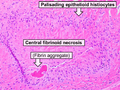 Histopathology of a rheumatoid nodule


Medical Disclaimer: WikiMD is for informational purposes only and is not a substitute for professional medical advice. Content may be inaccurate or outdated and should not be used for diagnosis or treatment. Always consult your healthcare provider for medical decisions. Verify information with trusted sources such as CDC.gov and NIH.gov. By using this site, you agree that WikiMD is not liable for any outcomes related to its content. See full disclaimer.
Credits:Most images are courtesy of Wikimedia commons, and templates, categories Wikipedia, licensed under CC BY SA or similar.
Translate page: - East Asian
中文,
日本,
한국어,
South Asian
हिन्दी,
தமிழ்,
తెలుగు,
Urdu,
ಕನ್ನಡ,
Southeast Asian
Indonesian,
Vietnamese,
Thai,
မြန်မာဘာသာ,
বাংলা
European
español,
Deutsch,
français,
Greek,
português do Brasil,
polski,
română,
русский,
Nederlands,
norsk,
svenska,
suomi,
Italian
Middle Eastern & African
عربى,
Turkish,
Persian,
Hebrew,
Afrikaans,
isiZulu,
Kiswahili,
Other
Bulgarian,
Hungarian,
Czech,
Swedish,
മലയാളം,
मराठी,
ਪੰਜਾਬੀ,
ગુજરાતી,
Portuguese,
Ukrainian


