Population genetics
Population genetics is a subfield of genetics that deals with genetic differences within and between populations, and is a part of evolutionary biology. Studies in this branch of biology examine such phenomena as adaptation, speciation, and population structure.
History[edit]
Population genetics was a vital ingredient in the emergence of the modern evolutionary synthesis. Its primary founders were Sewall Wright, J.B.S. Haldane and Ronald Fisher, who also laid the groundwork for the related discipline of quantitative genetics.
Genetic variation[edit]
Genetic variation is the basis for most evolutionary change and is therefore a central concept in population genetics. Genetic variation is caused by mutation, gene flow between populations, and sexual reproduction.
Genetic drift[edit]
Genetic drift is a change in allele frequency in a population, due to random sampling. The effects of genetic drift are most pronounced in small populations, where chance events can have a large impact on the genetic makeup of the population.
Natural selection[edit]
Natural selection is the process by which certain heritable traits—those that make it more likely for an organism to survive and successfully reproduce—become more common in a population over successive generations.
Gene flow[edit]
Gene flow is the transfer of genetic variation from one population to another. If the rate of gene flow is high enough, then two populations are considered to have equivalent allele frequencies and therefore effectively be a single population.
Mathematical models[edit]
The field of population genetics is heavily reliant on mathematical models, which describe the effects of various forces on the distribution of genetic variants within and between populations.
See also[edit]
References[edit]

-
 Synergistic versus antagonistic epistasis
 -
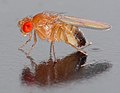 Drosophila melanogaster - side view
 -
 Gene flow
 -
 Population genetics
 -
 Tree Of Life with horizontal gene transfer

.jpg)


.svg)
Medical Disclaimer: WikiMD is for informational purposes only and is not a substitute for professional medical advice. Content may be inaccurate or outdated and should not be used for diagnosis or treatment. Always consult your healthcare provider for medical decisions. Verify information with trusted sources such as CDC.gov and NIH.gov. By using this site, you agree that WikiMD is not liable for any outcomes related to its content. See full disclaimer.
Credits:Most images are courtesy of Wikimedia commons, and templates, categories Wikipedia, licensed under CC BY SA or similar.
Translate this page: - East Asian
中文,
日本,
한국어,
South Asian
हिन्दी,
தமிழ்,
తెలుగు,
Urdu,
ಕನ್ನಡ,
Southeast Asian
Indonesian,
Vietnamese,
Thai,
မြန်မာဘာသာ,
বাংলা
European
español,
Deutsch,
français,
Greek,
português do Brasil,
polski,
română,
русский,
Nederlands,
norsk,
svenska,
suomi,
Italian
Middle Eastern & African
عربى,
Turkish,
Persian,
Hebrew,
Afrikaans,
isiZulu,
Kiswahili,
Other
Bulgarian,
Hungarian,
Czech,
Swedish,
മലയാളം,
मराठी,
ਪੰਜਾਬੀ,
ગુજરાતી,
Portuguese,
Ukrainian
