Oenothera biennis
Oenothera biennis, commonly known as the Evening Primrose, is a species of flowering plant native to North America. It is a biennial plant, meaning it completes its lifecycle over two years. The plant is well-known for its medicinal properties and is widely used in traditional medicine.
Description[edit]
The Oenothera biennis plant typically grows to a height of 30-150 cm. It has lanceolate leaves that are 5-20 cm long and 1-2.5 cm wide. The flowers are hermaphrodite, with four yellow petals that are 1-2 cm long. The fruit is a capsule 2-4 cm long and 4-6 mm broad, containing numerous 1-2 mm long seeds.
Distribution and Habitat[edit]
Oenothera biennis is native to eastern and central North America, from Newfoundland west to Alberta, southeast to Florida, and southwest to Texas. It is found in a variety of habitats, including dry, open woods, prairies, and disturbed areas.
Uses[edit]
The plant has a long history of medicinal use. The leaves, roots, and seed pods are all used in traditional medicine. The oil extracted from the seeds of Oenothera biennis, known as Evening Primrose Oil, is particularly valued for its high concentration of gamma-linolenic acid (GLA), a type of essential fatty acid.
Cultivation[edit]
Oenothera biennis is a hardy plant that can grow in a variety of soil types, although it prefers well-drained soil. It is drought-tolerant and can grow in full sun to partial shade.
Research[edit]
Research into the medicinal properties of Oenothera biennis has focused on the potential benefits of its oil. Studies have suggested that Evening Primrose Oil may have anti-inflammatory effects, and it has been investigated as a potential treatment for conditions such as eczema, rheumatoid arthritis, and premenstrual syndrome.
See Also[edit]
References[edit]

This flora-related article is a stub. You can help WikiMD by expanding it.
 | This medical article is a stub. You can help WikiMD by expanding the page. |
-
Nachtkerze mit Samenständen und Blüten
-
Oenothera biennis - Nachtkerze mit Samenständen und Blüten
-
Oenothera biennis, Vic-la-Gardiole
-
Illustration Oenothera biennis
-
 Oenothera
 -
Ola kwiatek żółty Niemirów nad Bugiem
-
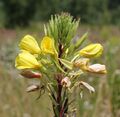 Oenothera rubricaulis 2014
 -
Animal insect Lepidoptera Schinia florida primose moth Oenothera 5b L Plymouth MA USA D 240724
-
Animal insect Lepidoptera Schinia florida primose moth Oenothera 38 L Plymouth MA USA D 240724


Medical Disclaimer: WikiMD is for informational purposes only and is not a substitute for professional medical advice. Content may be inaccurate or outdated and should not be used for diagnosis or treatment. Always consult your healthcare provider for medical decisions. Verify information with trusted sources such as CDC.gov and NIH.gov. By using this site, you agree that WikiMD is not liable for any outcomes related to its content. See full disclaimer.
Credits:Most images are courtesy of Wikimedia commons, and templates, categories Wikipedia, licensed under CC BY SA or similar.
Translate page: - East Asian
中文,
日本,
한국어,
South Asian
हिन्दी,
தமிழ்,
తెలుగు,
Urdu,
ಕನ್ನಡ,
Southeast Asian
Indonesian,
Vietnamese,
Thai,
မြန်မာဘာသာ,
বাংলা
European
español,
Deutsch,
français,
Greek,
português do Brasil,
polski,
română,
русский,
Nederlands,
norsk,
svenska,
suomi,
Italian
Middle Eastern & African
عربى,
Turkish,
Persian,
Hebrew,
Afrikaans,
isiZulu,
Kiswahili,
Other
Bulgarian,
Hungarian,
Czech,
Swedish,
മലയാളം,
मराठी,
ਪੰਜਾਬੀ,
ગુજરાતી,
Portuguese,
Ukrainian


