Euphorbia poissonii
Euphorbia poissonii is a species of Euphorbia, a large genus of flowering plants in the spurge family (Euphorbiaceae). It is commonly known as Poisson's Euphorbia or Nigerian sand spurge. This plant is native to the northern regions of Nigeria and Niger, where it grows in arid, sandy environments.
Description[edit]
Euphorbia poissonii is a perennial shrub that can grow up to 2.5 meters in height. Its stems are cylindrical and covered in small, sharp spines. The leaves are small, oval-shaped, and fall off during the dry season. The flowers, or cyathia, are small and greenish-yellow in color.
Toxicity[edit]
Euphorbia poissonii is notable for its high toxicity. The plant produces a milky sap, or latex, that contains a potent skin irritant and carcinogen known as diterpene esters. The most potent of these is resiniferatoxin, or RTX, which is one of the most powerful known capsaicinoids and is used in research on pain and inflammation.
Uses[edit]
Despite its toxicity, Euphorbia poissonii has been used in traditional medicine in its native regions. The latex has been used to treat skin conditions, and the roots have been used to treat digestive disorders. However, due to the high toxicity of the plant, its use is generally not recommended without proper knowledge and precautions.
Conservation[edit]
Euphorbia poissonii is not currently considered to be at risk of extinction. However, like many desert plants, it may be threatened by climate change and habitat loss.
See also[edit]
 | This Euphorbiaceae-related article is a stub. You can help WikiMD by expanding the page. |
This toxic plant related article is a stub. You can help WikiMD by expanding it.
-
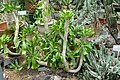 Euphorbia poissonii at the Food and Agriculture Museum, Setagaya, Tokyo, Japan


Medical Disclaimer: WikiMD is for informational purposes only and is not a substitute for professional medical advice. Content may be inaccurate or outdated and should not be used for diagnosis or treatment. Always consult your healthcare provider for medical decisions. Verify information with trusted sources such as CDC.gov and NIH.gov. By using this site, you agree that WikiMD is not liable for any outcomes related to its content. See full disclaimer.
Credits:Most images are courtesy of Wikimedia commons, and templates, categories Wikipedia, licensed under CC BY SA or similar.
Translate page: - East Asian
中文,
日本,
한국어,
South Asian
हिन्दी,
தமிழ்,
తెలుగు,
Urdu,
ಕನ್ನಡ,
Southeast Asian
Indonesian,
Vietnamese,
Thai,
မြန်မာဘာသာ,
বাংলা
European
español,
Deutsch,
français,
Greek,
português do Brasil,
polski,
română,
русский,
Nederlands,
norsk,
svenska,
suomi,
Italian
Middle Eastern & African
عربى,
Turkish,
Persian,
Hebrew,
Afrikaans,
isiZulu,
Kiswahili,
Other
Bulgarian,
Hungarian,
Czech,
Swedish,
മലയാളം,
मराठी,
ਪੰਜਾਬੀ,
ગુજરાતી,
Portuguese,
Ukrainian

