Euclidean vector
Euclidean vector
A Euclidean vector (also known as a geometric vector or simply a vector) is a geometric object that possesses both a magnitude and a direction. A vector can be represented as an arrow pointing from one point to another in a Euclidean space. The length of the arrow represents the vector's magnitude, while the direction in which the arrow points represents the vector's direction.
Definition[edit]
In mathematics, particularly in linear algebra and physics, a Euclidean vector is typically represented in a Cartesian coordinate system by ordered pairs or triples of real numbers. These numbers denote the vector's components along the Cartesian axes. For example, in a three-dimensional space, a vector can be represented as (x, y, z), where x, y, and z are the components of the vector.
Properties[edit]
Euclidean vectors have several important properties that make them fundamental in the study of linear algebra and physics. These include:
- Addition: Two vectors can be added together to form a new vector, known as the resultant vector, which is obtained by placing the tail of the second vector at the head of the first vector and then drawing a vector from the tail of the first vector to the head of the second vector.
- Scalar multiplication: A vector can be multiplied by a scalar (a real number), resulting in a new vector whose magnitude is scaled by the absolute value of the scalar, and whose direction is the same as the original vector if the scalar is positive, and opposite if the scalar is negative.
- Dot product: Also known as the scalar product, the dot product of two vectors is a scalar that reflects the degree of parallelism between the vectors.
- Cross product: In three-dimensional space, the cross product of two vectors is a vector that is perpendicular to the plane containing the two vectors, with a direction given by the right-hand rule and a magnitude equal to the area of the parallelogram that the vectors span.
Applications[edit]
Euclidean vectors are used in various scientific fields, including physics, engineering, computer science, and mathematics, due to their ability to succinctly represent points, directions, and velocities. In physics, vectors are used to describe quantities that have both magnitude and direction, such as force, velocity, and acceleration. In computer graphics, vectors are used to represent the positions and orientations of objects in a virtual space.
See also[edit]
References[edit]
<references/>

This article is a mathematics-related stub. You can help WikiMD by expanding it!
Euclidean vector gallery[edit]
-
 Vector from A to B
 -
Vector from A to B
-
 Notation for vectors in or out of a plane
 -
 Position vector
 -
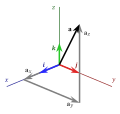 3D Vector
 -
 Surface normal tangent
 -
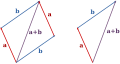 Vector addition
 -
 Vector subtraction
 -
 Scalar multiplication by r=3
 -
 Scalar multiplication of vectors


Ad. Transform your life with W8MD's Budget GLP-1 injections from $75


W8MD offers a medical weight loss program to lose weight in Philadelphia. Our physician-supervised medical weight loss provides:
- Weight loss injections in NYC (generic and brand names):
- Zepbound / Mounjaro, Wegovy / Ozempic, Saxenda
- Most insurances accepted or discounted self-pay rates. We will obtain insurance prior authorizations if needed.
- Generic GLP1 weight loss injections from $75 for the starting dose.
- Also offer prescription weight loss medications including Phentermine, Qsymia, Diethylpropion, Contrave etc.
NYC weight loss doctor appointmentsNYC weight loss doctor appointments
Start your NYC weight loss journey today at our NYC medical weight loss and Philadelphia medical weight loss clinics.
- Call 718-946-5500 to lose weight in NYC or for medical weight loss in Philadelphia 215-676-2334.
- Tags:NYC medical weight loss, Philadelphia lose weight Zepbound NYC, Budget GLP1 weight loss injections, Wegovy Philadelphia, Wegovy NYC, Philadelphia medical weight loss, Brookly weight loss and Wegovy NYC


|
WikiMD's Wellness Encyclopedia |
| Let Food Be Thy Medicine Medicine Thy Food - Hippocrates |
Medical Disclaimer: WikiMD is not a substitute for professional medical advice. The information on WikiMD is provided as an information resource only, may be incorrect, outdated or misleading, and is not to be used or relied on for any diagnostic or treatment purposes. Please consult your health care provider before making any healthcare decisions or for guidance about a specific medical condition. WikiMD expressly disclaims responsibility, and shall have no liability, for any damages, loss, injury, or liability whatsoever suffered as a result of your reliance on the information contained in this site. By visiting this site you agree to the foregoing terms and conditions, which may from time to time be changed or supplemented by WikiMD. If you do not agree to the foregoing terms and conditions, you should not enter or use this site. See full disclaimer.
Credits:Most images are courtesy of Wikimedia commons, and templates, categories Wikipedia, licensed under CC BY SA or similar.
Translate this page: - East Asian
中文,
日本,
한국어,
South Asian
हिन्दी,
தமிழ்,
తెలుగు,
Urdu,
ಕನ್ನಡ,
Southeast Asian
Indonesian,
Vietnamese,
Thai,
မြန်မာဘာသာ,
বাংলা
European
español,
Deutsch,
français,
Greek,
português do Brasil,
polski,
română,
русский,
Nederlands,
norsk,
svenska,
suomi,
Italian
Middle Eastern & African
عربى,
Turkish,
Persian,
Hebrew,
Afrikaans,
isiZulu,
Kiswahili,
Other
Bulgarian,
Hungarian,
Czech,
Swedish,
മലയാളം,
मराठी,
ਪੰਜਾਬੀ,
ગુજરાતી,
Portuguese,
Ukrainian
