Esophageal web

Editor-In-Chief: Prab R Tumpati, MD
Obesity, Sleep & Internal medicine
Founder, WikiMD Wellnesspedia &
W8MD's weight loss doctor NYC
Philadelphia GLP-1 weight loss and GLP-1 clinic NYC
| Esophageal web | |
|---|---|

| |
| Synonyms | N/A |
| Pronounce | N/A |
| Specialty | N/A |
| Symptoms | Dysphagia, odynophagia, iron deficiency anemia |
| Complications | Esophageal cancer |
| Onset | Any age, more common in adults |
| Duration | Chronic |
| Types | N/A |
| Causes | Plummer-Vinson syndrome, congenital |
| Risks | Iron deficiency, autoimmune disorders |
| Diagnosis | Barium swallow, endoscopy |
| Differential diagnosis | Esophageal stricture, esophageal ring |
| Prevention | N/A |
| Treatment | Endoscopic dilation, iron supplementation |
| Medication | N/A |
| Prognosis | Good with treatment |
| Frequency | Rare |
| Deaths | N/A |
Esophageal web is a thin, membrane-like tissue growth that occurs in the esophagus. It is a rare condition that can cause difficulty swallowing and other symptoms.
Causes[edit]
The exact cause of esophageal web is unknown. However, it is often associated with certain conditions such as iron deficiency anemia, Plummer-Vinson syndrome, and celiac disease.
Symptoms[edit]
The most common symptom of esophageal web is difficulty swallowing, also known as dysphagia. Other symptoms may include pain or discomfort in the chest, weight loss, and regurgitation of food.
Diagnosis[edit]
Esophageal web is typically diagnosed through a procedure called an endoscopy, where a thin tube with a camera is inserted down the throat to examine the esophagus. Other diagnostic tests may include a barium swallow or an esophagram.
Treatment[edit]
Treatment for esophageal web often involves a procedure to stretch or remove the web. This can be done through an endoscopy or a surgical procedure. In some cases, treatment for the underlying condition, such as iron supplementation for iron deficiency anemia, may also be necessary.
Esophageal web images[edit]
-
 Zervikales Web
 -
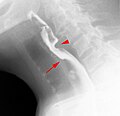 Web mit Jet-Phaenomen
 -
 Zervikales Web pa


See also[edit]
References[edit]


Medical Disclaimer: WikiMD is for informational purposes only and is not a substitute for professional medical advice. Content may be inaccurate or outdated and should not be used for diagnosis or treatment. Always consult your healthcare provider for medical decisions. Verify information with trusted sources such as CDC.gov and NIH.gov. By using this site, you agree that WikiMD is not liable for any outcomes related to its content. See full disclaimer.
Credits:Most images are courtesy of Wikimedia commons, and templates, categories Wikipedia, licensed under CC BY SA or similar.
Translate page: - East Asian
中文,
日本,
한국어,
South Asian
हिन्दी,
தமிழ்,
తెలుగు,
Urdu,
ಕನ್ನಡ,
Southeast Asian
Indonesian,
Vietnamese,
Thai,
မြန်မာဘာသာ,
বাংলা
European
español,
Deutsch,
français,
Greek,
português do Brasil,
polski,
română,
русский,
Nederlands,
norsk,
svenska,
suomi,
Italian
Middle Eastern & African
عربى,
Turkish,
Persian,
Hebrew,
Afrikaans,
isiZulu,
Kiswahili,
Other
Bulgarian,
Hungarian,
Czech,
Swedish,
മലയാളം,
मराठी,
ਪੰਜਾਬੀ,
ગુજરાતી,
Portuguese,
Ukrainian

