Esophageal food bolus obstruction

Editor-In-Chief: Prab R Tumpati, MD
Obesity, Sleep & Internal medicine
Founder, WikiMD Wellnesspedia &
W8MD's weight loss doctor NYC
Philadelphia GLP-1 weight loss and GLP-1 clinic NYC
| Esophageal food bolus obstruction | |
|---|---|
.jpg)
| |
| Synonyms | N/A |
| Pronounce | N/A |
| Specialty | N/A |
| Symptoms | Dysphagia, chest pain, regurgitation |
| Complications | Esophageal perforation, aspiration pneumonia |
| Onset | Sudden |
| Duration | Until relieved |
| Types | N/A |
| Causes | Eosinophilic esophagitis, esophageal stricture, achalasia, esophageal cancer |
| Risks | Eating large pieces of food, inadequate chewing, underlying esophageal conditions |
| Diagnosis | Endoscopy, barium swallow |
| Differential diagnosis | Heart attack, gastroesophageal reflux disease |
| Prevention | N/A |
| Treatment | Endoscopic removal, glucagon |
| Medication | Glucagon, nifedipine |
| Prognosis | N/A |
| Frequency | Common in individuals with underlying esophageal conditions |
| Deaths | N/A |
Esophageal food bolus obstruction (EFBO) is a medical condition characterized by the impaction of a food bolus in the esophagus. This condition can lead to difficulty swallowing (dysphagia), pain, and potentially serious complications if not promptly addressed. EFBO is considered a gastrointestinal emergency and requires immediate medical attention.
Causes[edit]
EFBO is most commonly caused by an underlying esophageal disorder that narrows the esophagus, making it difficult for food to pass. These conditions include:
- Esophageal stricture: Narrowing of the esophagus due to scar tissue, often resulting from chronic gastroesophageal reflux disease (GERD) or radiation therapy.
- Eosinophilic esophagitis: An allergic condition causing inflammation and narrowing of the esophagus.
- Esophageal cancer: A malignant tumor that can obstruct the passage of food.
- Achalasia: A disorder affecting the ability of the esophagus to move food toward the stomach.
Symptoms[edit]
The primary symptom of EFBO is the sudden onset of dysphagia, especially with solid foods. Other symptoms may include:
- Pain or discomfort in the chest
- Regurgitation of food
- Salivation
- Coughing or choking (if the food enters the airway)
Diagnosis[edit]
Diagnosis of EFBO typically involves a combination of medical history, physical examination, and diagnostic tests, including:
- X-ray with a barium swallow: A special type of X-ray that visualizes the esophagus after the patient swallows a barium solution.
- Endoscopy: A procedure using a flexible tube with a camera to visually inspect the esophagus and remove the food bolus.
Treatment[edit]
Treatment for EFBO aims to remove the obstruction and address the underlying cause. Methods include:
- Endoscopic removal: The most common and effective treatment, where an endoscope is used to either push the food bolus into the stomach or extract it.
- Pharmacological treatment: The use of glucagon or nitroglycerin to relax the esophageal muscles and facilitate the passage of the food bolus.
- Esophageal dilation: Widening of the esophagus using a balloon or dilators to prevent future obstructions.
Prevention[edit]
Prevention of EFBO involves managing underlying esophageal conditions, chewing food thoroughly, and avoiding large bites of hard-to-swallow foods.
Complications[edit]
If not treated promptly, EFBO can lead to complications such as:
- Aspiration pneumonia: Inhalation of food particles into the lungs.
- Esophageal perforation: A tear in the esophagus, leading to a serious infection.
- Airway obstruction: A life-threatening condition if the food bolus blocks the airway.
Images[edit]
-
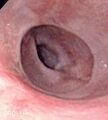 Schatzki ring
 -
 Roth net
 -
 Diagram of esophagus and stomach


See Also[edit]
 | This medical article is a stub. You can help WikiMD by expanding the page. |

Medical Disclaimer: WikiMD is for informational purposes only and is not a substitute for professional medical advice. Content may be inaccurate or outdated and should not be used for diagnosis or treatment. Always consult your healthcare provider for medical decisions. Verify information with trusted sources such as CDC.gov and NIH.gov. By using this site, you agree that WikiMD is not liable for any outcomes related to its content. See full disclaimer.
Credits:Most images are courtesy of Wikimedia commons, and templates, categories Wikipedia, licensed under CC BY SA or similar.
Translate page: - East Asian
中文,
日本,
한국어,
South Asian
हिन्दी,
தமிழ்,
తెలుగు,
Urdu,
ಕನ್ನಡ,
Southeast Asian
Indonesian,
Vietnamese,
Thai,
မြန်မာဘာသာ,
বাংলা
European
español,
Deutsch,
français,
Greek,
português do Brasil,
polski,
română,
русский,
Nederlands,
norsk,
svenska,
suomi,
Italian
Middle Eastern & African
عربى,
Turkish,
Persian,
Hebrew,
Afrikaans,
isiZulu,
Kiswahili,
Other
Bulgarian,
Hungarian,
Czech,
Swedish,
മലയാളം,
मराठी,
ਪੰਜਾਬੀ,
ગુજરાતી,
Portuguese,
Ukrainian

