Epidemiology of suicide
The epidemiology of suicide involves the study of the distribution, determinants, and deterrents of suicide among populations. Understanding the epidemiological patterns of suicide is crucial for the development and implementation of prevention strategies. This article delves into various aspects of suicide epidemiology, including global trends, risk factors, and preventive measures.
Global Trends[edit]
Suicide is a significant public health issue worldwide, with over 700,000 people dying by suicide every year according to the World Health Organization (WHO). The global age-standardized suicide rate is 9.0 per 100,000 population. However, there are substantial variations in suicide rates between countries and regions, influenced by cultural, societal, and economic factors. High-income countries tend to have higher suicide rates compared to low- and middle-income countries, but the latter account for the majority of suicide deaths globally due to their larger population size.
Risk Factors[edit]
Several factors increase the risk of suicide, including but not limited to mental health disorders (such as depression, bipolar disorder, and schizophrenia), substance use disorder, chronic pain, a history of trauma or abuse, and significant life stressors or changes. Social isolation and lack of social support are also significant risk factors. Additionally, access to means of suicide can affect suicide rates; for example, countries with higher rates of firearm ownership often have higher rates of suicide by firearm.
Preventive Measures[edit]
Preventing suicide requires a multifaceted approach. Strategies include improving mental health care access and quality, reducing stigma associated with seeking help for mental health issues, restricting access to means of suicide, and providing support for those affected by suicidal thoughts or behaviors. Education and awareness programs are also vital in changing public perceptions and encouraging help-seeking behavior.
Epidemiological Studies[edit]
Epidemiological studies on suicide often utilize data from death certificates, hospital records, and surveys to identify patterns and risk factors. These studies help in understanding how suicide rates vary by demographic factors such as age, gender, and socioeconomic status. For instance, globally, suicide rates are higher among men than women, and there is a peak in suicide rates among the elderly. However, there is an increasing concern about rising suicide rates among young people in several countries.
Challenges in Suicide Epidemiology[edit]
One of the main challenges in studying the epidemiology of suicide is underreporting and misclassification of suicide deaths, which can lead to inaccuracies in suicide statistics. Cultural and societal attitudes towards suicide can influence whether deaths are reported and recorded as suicides. Additionally, there is a need for more comprehensive data collection and research in low- and middle-income countries to better understand the epidemiology of suicide in these regions.
Conclusion[edit]
The epidemiology of suicide is a complex field that requires ongoing research and intervention to effectively address and reduce suicide rates worldwide. By understanding the patterns and risk factors associated with suicide, health professionals and policymakers can develop targeted prevention strategies to save lives.
 | This medical article is a stub. You can help WikiMD by expanding the page. |
Epidemiology of suicide[edit]
-
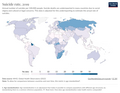 Death rate from suicides
 -
 Share of deaths from suicide
 -
 Male suicide rates 2015 (crude)
 -
 Female suicide rates 2015 (crude)
 -
 Suicides by race, Hispanic gender, and age 1999-2005
 -
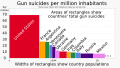 2019 Gun suicides per capita - by country
 -
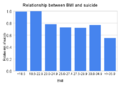 Relationship between BMI and suicide


.svg)
.svg)


Medical Disclaimer: WikiMD is for informational purposes only and is not a substitute for professional medical advice. Content may be inaccurate or outdated and should not be used for diagnosis or treatment. Always consult your healthcare provider for medical decisions. Verify information with trusted sources such as CDC.gov and NIH.gov. By using this site, you agree that WikiMD is not liable for any outcomes related to its content. See full disclaimer.
Credits:Most images are courtesy of Wikimedia commons, and templates, categories Wikipedia, licensed under CC BY SA or similar.
Translate page: - East Asian
中文,
日本,
한국어,
South Asian
हिन्दी,
தமிழ்,
తెలుగు,
Urdu,
ಕನ್ನಡ,
Southeast Asian
Indonesian,
Vietnamese,
Thai,
မြန်မာဘာသာ,
বাংলা
European
español,
Deutsch,
français,
Greek,
português do Brasil,
polski,
română,
русский,
Nederlands,
norsk,
svenska,
suomi,
Italian
Middle Eastern & African
عربى,
Turkish,
Persian,
Hebrew,
Afrikaans,
isiZulu,
Kiswahili,
Other
Bulgarian,
Hungarian,
Czech,
Swedish,
മലയാളം,
मराठी,
ਪੰਜਾਬੀ,
ગુજરાતી,
Portuguese,
Ukrainian

