Enzyme

Editor-In-Chief: Prab R Tumpati, MD
Obesity, Sleep & Internal medicine
Founder, WikiMD Wellnesspedia &
W8MD's medical weight loss NYC, sleep center NYC
Philadelphia medical weight loss and Philadelphia sleep clinics


Enzymes are large biological molecules that play a crucial role in sustaining life. They drive thousands of metabolic processes that are essential for the survival of organisms. Their primary function is to act as highly selective catalysts, greatly enhancing both the speed and specificity of metabolic reactions. These reactions range from the digestion of food to the intricate synthesis of DNA.
Structure and Composition[edit]
The majority of enzymes are proteins. However, there are also catalytic RNA molecules that have been recognized as enzymes. Enzymes are characterized by their specific three-dimensional structures. To facilitate their catalytic action, enzymes might utilize organic cofactors, such as biotin, or inorganic cofactors, for instance, the magnesium ion.
Functionality[edit]
Enzymatic Reactions[edit]
In enzymatic reactions, the starting molecules or substrates undergo conversion to form different molecules, known as products. For a biological cell to function efficiently and sustain life, nearly all its chemical reactions necessitate enzymes. This is because enzymes accelerate these reactions to rates that are conducive to life. Their selectivity for substrates means that they only expedite specific reactions among myriad possibilities. This specificity is the reason the array of enzymes present in a cell dictates the metabolic pathways that the cell will undertake.
Catalytic Mechanism[edit]
Just like other catalysts, enzymes function by diminishing the activation energy (Ea‡) necessary for a reaction. This results in an exponential increase in the reaction rate. Consequently, products form at a much quicker rate, and reactions attain their equilibrium faster. Notably, enzyme reaction rates can be up to millions of times faster than those of equivalent un-catalyzed reactions. Despite their impressive catalytic ability, enzymes are neither consumed in the reactions they facilitate nor do they modify the reactions' equilibrium. However, they do stand out from many other catalysts due to their remarkable substrate specificity. Currently, enzymes are documented to catalyze approximately 4,000 biochemical reactions. There are also RNA molecules termed ribozymes that have a catalytic function, with parts of the ribosome serving as a prime example. Furthermore, synthetic molecules, referred to as artificial enzymes, exhibit enzyme-like catalysis.
Regulation and Interactions[edit]
Various molecules can influence enzyme activity. While inhibitors are molecules that diminish enzyme activity, activators are ones that enhance it. Numerous drugs and poisons function as enzyme inhibitors. Factors like temperature, pressure, chemical environment (such as pH), and substrate concentration can also impact enzyme activity.
Commercial and Practical Applications[edit]
Several enzymes find commercial applications. For instance, some are employed in the synthesis of antibiotics. Household products also harness the power of enzymes to expedite biochemical reactions. For example, biological washing powders contain enzymes that break down protein or fat stains on clothes. Likewise, enzymes in meat tenderizers decompose proteins into smaller molecules, rendering the meat more tender and easier to chew.
Gallery[edit]
-
 Hexokinase induced fit
 -
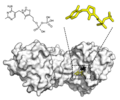 Transketolase + TPP
 -
 Enzyme catalysis energy levels
 -
 Enzyme mechanism
 -
 Michaelis Menten curve
 -
 DHFR methotrexate inhibitor
 -
 Methotrexate vs folate


See Also[edit]
 | |
|---|---|
 |
 |
| Food chemistry |
|---|
|
|
| Enzymes | ||||||||||
|---|---|---|---|---|---|---|---|---|---|---|
|
Ad. Transform your life with W8MD's
GLP-1 weight loss injections special from $29.99 with insurance
|
WikiMD Medical Encyclopedia |
Medical Disclaimer: WikiMD is for informational purposes only and is not a substitute for professional medical advice. Content may be inaccurate or outdated and should not be used for diagnosis or treatment. Always consult your healthcare provider for medical decisions. Verify information with trusted sources such as CDC.gov and NIH.gov. By using this site, you agree that WikiMD is not liable for any outcomes related to its content. See full disclaimer.
Credits:Most images are courtesy of Wikimedia commons, and templates, categories Wikipedia, licensed under CC BY SA or similar.
Translate this page: - East Asian
中文,
日本,
한국어,
South Asian
हिन्दी,
தமிழ்,
తెలుగు,
Urdu,
ಕನ್ನಡ,
Southeast Asian
Indonesian,
Vietnamese,
Thai,
မြန်မာဘာသာ,
বাংলা
European
español,
Deutsch,
français,
Greek,
português do Brasil,
polski,
română,
русский,
Nederlands,
norsk,
svenska,
suomi,
Italian
Middle Eastern & African
عربى,
Turkish,
Persian,
Hebrew,
Afrikaans,
isiZulu,
Kiswahili,
Other
Bulgarian,
Hungarian,
Czech,
Swedish,
മലയാളം,
मराठी,
ਪੰਜਾਬੀ,
ગુજરાતી,
Portuguese,
Ukrainian
