Entamoeba coli
Entamoeba coli is a non-pathogenic species of amoebae that is commonly found in the human gastrointestinal tract. It is a member of the genus Entamoeba, which includes several species of amoebae, some of which are pathogenic.
Overview[edit]
Entamoeba coli is a single-celled microorganism that is typically found in the large intestine of humans and other primates. Unlike other species of Entamoeba, such as Entamoeba histolytica, E. coli is not associated with disease and is considered a normal part of the intestinal flora.
Morphology[edit]
The morphology of E. coli is similar to other species of Entamoeba. It has a single nucleus and a cytoplasm that is divided into a clear outer zone, known as the ectoplasm, and a granular inner zone, known as the endoplasm. The nucleus of E. coli is distinctive, with a central karyosome and peripheral chromatin that is evenly distributed.
Life Cycle[edit]
The life cycle of E. coli involves two stages: the trophozoite stage and the cyst stage. The trophozoite is the active, feeding stage of the amoeba, while the cyst is the dormant, non-feeding stage. The cysts of E. coli are excreted in the feces and can survive in the environment for several weeks, providing a means of transmission.
Transmission[edit]
E. coli is transmitted via the fecal-oral route. This can occur through the ingestion of contaminated food or water, or through direct person-to-person contact. The cysts of E. coli are resistant to environmental conditions and can survive outside the body for extended periods.
Diagnosis[edit]
The diagnosis of E. coli infection is typically made by microscopic examination of stool samples. The cysts and trophozoites of E. coli can be identified by their characteristic morphology.
Treatment[edit]
As E. coli is not associated with disease, treatment is not typically required. However, in cases where E. coli is found in association with symptoms of gastrointestinal disease, treatment may be indicated to rule out the presence of other, pathogenic species of Entamoeba.
See Also[edit]
Entamoeba_coli[edit]
-
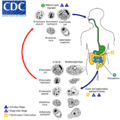 Lifecycle of common non-pathogenic parasites
 -
Entamoeba coli cyst with 6 nuclei
-
Stages of Entamoeba coli


Medical Disclaimer: WikiMD is for informational purposes only and is not a substitute for professional medical advice. Content may be inaccurate or outdated and should not be used for diagnosis or treatment. Always consult your healthcare provider for medical decisions. Verify information with trusted sources such as CDC.gov and NIH.gov. By using this site, you agree that WikiMD is not liable for any outcomes related to its content. See full disclaimer.
Credits:Most images are courtesy of Wikimedia commons, and templates, categories Wikipedia, licensed under CC BY SA or similar.
Translate page: - East Asian
中文,
日本,
한국어,
South Asian
हिन्दी,
தமிழ்,
తెలుగు,
Urdu,
ಕನ್ನಡ,
Southeast Asian
Indonesian,
Vietnamese,
Thai,
မြန်မာဘာသာ,
বাংলা
European
español,
Deutsch,
français,
Greek,
português do Brasil,
polski,
română,
русский,
Nederlands,
norsk,
svenska,
suomi,
Italian
Middle Eastern & African
عربى,
Turkish,
Persian,
Hebrew,
Afrikaans,
isiZulu,
Kiswahili,
Other
Bulgarian,
Hungarian,
Czech,
Swedish,
മലയാളം,
मराठी,
ਪੰਜਾਬੀ,
ગુજરાતી,
Portuguese,
Ukrainian


