Emergency medical services in Hong Kong
Emergency Medical Services in Hong Kong (EMS) are a critical component of the healthcare system, providing rapid medical response and care to individuals in need of urgent medical attention. The EMS system in Hong Kong is known for its efficiency, advanced technology, and highly trained personnel. This article provides an in-depth look at the structure, operation, and challenges of emergency medical services in Hong Kong.
Overview[edit]
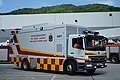
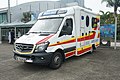
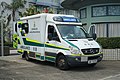
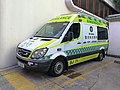
Emergency Medical Services in Hong Kong are primarily provided by the Hong Kong Fire Services Department (FSD), specifically through its Ambulance Command. The Ambulance Command is responsible for offering pre-hospital care and transportation to hospitals for those in need. It operates a fleet of ambulances equipped with state-of-the-art medical technologies and staffed by highly trained paramedics and emergency medical technicians (EMTs).
Structure[edit]
The EMS system in Hong Kong is structured to ensure rapid response and high-quality medical care. The system includes several key components:
- Ambulance Services: The backbone of EMS, providing emergency medical response and transportation.
- Emergency Dispatch Center: Operates 24/7, handling emergency calls and dispatching ambulances.
- Paramedics and EMTs: Trained professionals who provide pre-hospital care.
- Emergency Departments: Hospitals with emergency departments that work closely with EMS to provide continuum of care.
Operation[edit]
The operation of EMS in Hong Kong is characterized by its use of advanced technology and protocols to ensure quick and efficient service. Key operational aspects include:
- Emergency Call Handling: Utilizes a Computer-Aided Dispatch (CAD) system to prioritize calls and dispatch services.
- Advanced Life Support (ALS): Provided by paramedics in ambulances, including defibrillation, airway management, and drug administration.
- Basic Life Support (BLS): Provided by EMTs, focusing on stabilizing patients with non-invasive techniques.
Challenges[edit]
Despite its strengths, the EMS system in Hong Kong faces several challenges:
- Increasing Demand: Rising call volumes strain resources and response times.
- Urban Congestion: Traffic congestion in densely populated areas can delay ambulance response.
- Public Awareness: Enhancing public knowledge on when to use EMS can help manage demand.
Future Directions[edit]
To address these challenges and improve services, future directions may include:
- Technology Integration: Further integration of technology to enhance dispatch and response efficiency.
- Public Education: Campaigns to educate the public on the appropriate use of EMS.
- Training and Development: Ongoing training for EMS personnel to handle complex medical scenarios.
Conclusion[edit]
Emergency Medical Services in Hong Kong play a vital role in the city's healthcare system, offering rapid and competent medical response. Through continuous improvement and adaptation to challenges, Hong Kong's EMS aims to maintain its high standard of care and efficiency.
 | This medical article is a stub. You can help WikiMD by expanding the page. |
-
 Emergency medical services in Hong Kong
 -
 Emergency medical services in Hong Kong
 -
 Emergency medical services in Hong Kong
 -
 Emergency medical services in Hong Kong
 -
 Emergency medical services in Hong Kong
 -
 Emergency medical services in Hong Kong
 -
 Emergency medical services in Hong Kong
 -
 Emergency medical services in Hong Kong
 -
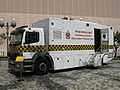 Emergency medical services in Hong Kong

.jpg)


.JPG)


Medical Disclaimer: WikiMD is for informational purposes only and is not a substitute for professional medical advice. Content may be inaccurate or outdated and should not be used for diagnosis or treatment. Always consult your healthcare provider for medical decisions. Verify information with trusted sources such as CDC.gov and NIH.gov. By using this site, you agree that WikiMD is not liable for any outcomes related to its content. See full disclaimer.
Credits:Most images are courtesy of Wikimedia commons, and templates, categories Wikipedia, licensed under CC BY SA or similar.
Translate page: - East Asian
中文,
日本,
한국어,
South Asian
हिन्दी,
தமிழ்,
తెలుగు,
Urdu,
ಕನ್ನಡ,
Southeast Asian
Indonesian,
Vietnamese,
Thai,
မြန်မာဘာသာ,
বাংলা
European
español,
Deutsch,
français,
Greek,
português do Brasil,
polski,
română,
русский,
Nederlands,
norsk,
svenska,
suomi,
Italian
Middle Eastern & African
عربى,
Turkish,
Persian,
Hebrew,
Afrikaans,
isiZulu,
Kiswahili,
Other
Bulgarian,
Hungarian,
Czech,
Swedish,
മലയാളം,
मराठी,
ਪੰਜਾਬੀ,
ગુજરાતી,
Portuguese,
Ukrainian

