Elastase
Elastase is a type of enzyme that breaks down elastin, a protein that gives elasticity to tissues in the body. It is produced by certain white blood cells and is involved in the body's immune response. There are several types of elastase, including neutrophil elastase and pancreatic elastase, which are produced in different parts of the body and have different functions.
Function[edit]
Elastase helps the body to fight infections by breaking down the walls of bacteria, making them easier for the immune system to destroy. It also plays a role in inflammation, a process that helps to protect the body from injury and infection. However, if too much elastase is produced, it can damage healthy tissues and contribute to diseases such as chronic obstructive pulmonary disease (COPD) and cystic fibrosis.
Role in Disease[edit]
Elastase has been implicated in a number of diseases. In COPD, for example, an overproduction of elastase can lead to the destruction of lung tissue, making it difficult for the person to breathe. In cystic fibrosis, a genetic mutation causes the body to produce a thick, sticky mucus that can block the airways and lead to lung infections. Elastase is thought to contribute to the damage to the lungs in this disease.
Measurement[edit]
The level of elastase in the body can be measured using a blood test or a stool test. These tests can help doctors to diagnose conditions such as pancreatic insufficiency, a condition in which the pancreas does not produce enough enzymes to digest food properly.
Treatment[edit]
In some cases, drugs that inhibit the action of elastase can be used to treat conditions such as COPD and cystic fibrosis. These drugs work by reducing the amount of elastase in the body, helping to prevent damage to tissues.
See Also[edit]
- Enzyme
- White blood cells
- Chronic obstructive pulmonary disease
- Cystic fibrosis
- Pancreatic insufficiency

This WikiMD article can only be edited by registered and verified editors. You can log in or register.
-
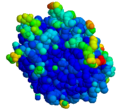 Elastase
 -
 Protein Crystal Growth of Porcine Elastase
 -
 3D Structure of Daminozide


Medical Disclaimer: WikiMD is for informational purposes only and is not a substitute for professional medical advice. Content may be inaccurate or outdated and should not be used for diagnosis or treatment. Always consult your healthcare provider for medical decisions. Verify information with trusted sources such as CDC.gov and NIH.gov. By using this site, you agree that WikiMD is not liable for any outcomes related to its content. See full disclaimer.
Credits:Most images are courtesy of Wikimedia commons, and templates, categories Wikipedia, licensed under CC BY SA or similar.
Translate page: - East Asian
中文,
日本,
한국어,
South Asian
हिन्दी,
தமிழ்,
తెలుగు,
Urdu,
ಕನ್ನಡ,
Southeast Asian
Indonesian,
Vietnamese,
Thai,
မြန်မာဘာသာ,
বাংলা
European
español,
Deutsch,
français,
Greek,
português do Brasil,
polski,
română,
русский,
Nederlands,
norsk,
svenska,
suomi,
Italian
Middle Eastern & African
عربى,
Turkish,
Persian,
Hebrew,
Afrikaans,
isiZulu,
Kiswahili,
Other
Bulgarian,
Hungarian,
Czech,
Swedish,
മലയാളം,
मराठी,
ਪੰਜਾਬੀ,
ગુજરાતી,
Portuguese,
Ukrainian

