Economic surplus
Economic Surplus[edit]
Economic surplus is a fundamental concept in economics that refers to the benefits that individuals or society receive from engaging in economic activities. It is the sum of consumer surplus and producer surplus, representing the total net benefit to society from the production and consumption of goods and services.
Consumer Surplus[edit]
Consumer surplus is the difference between what consumers are willing to pay for a good or service and what they actually pay. It measures the benefit consumers receive when they purchase a product for less than the maximum price they are willing to pay.
Calculation[edit]
Consumer surplus can be calculated using the demand curve. It is the area below the demand curve and above the price level, up to the quantity purchased. Mathematically, it can be expressed as:
where is the demand price, is the market price, and is the quantity.
Producer Surplus[edit]
Producer surplus is the difference between what producers are willing to accept for a good or service and what they actually receive. It represents the benefit producers receive when they sell a product for more than the minimum price they are willing to accept.
Calculation[edit]
Producer surplus can be calculated using the supply curve. It is the area above the supply curve and below the price level, up to the quantity sold. Mathematically, it can be expressed as:
where is the supply price, is the market price, and is the quantity.
Total Economic Surplus[edit]
Total economic surplus is the sum of consumer surplus and producer surplus. It represents the total net benefit to society from the production and consumption of a good or service. Maximizing economic surplus is often a goal of economic policy, as it indicates an efficient allocation of resources.
Importance in Economics[edit]
Economic surplus is a key indicator of economic efficiency. It is used to assess the welfare effects of different market structures, government policies, and externalities. For example, in a perfectly competitive market, economic surplus is maximized, indicating an efficient allocation of resources. In contrast, monopolies or other market failures can lead to a reduction in economic surplus, indicating inefficiency.
Related Concepts[edit]
- Deadweight loss: The loss of economic surplus due to market inefficiencies, such as taxes or monopolies.
- Pareto efficiency: A state where no individual can be made better off without making someone else worse off, often associated with maximum economic surplus.
- Welfare economics: The study of how economic activity affects social welfare, often using economic surplus as a measure.
References[edit]
- Varian, H. R. (2010). Intermediate Microeconomics: A Modern Approach. W.W. Norton & Company.
- Mankiw, N. G. (2014). Principles of Economics. Cengage Learning.
-
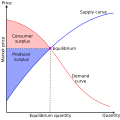 Economic Surpluses Diagram
 -
 Producer Surplus Graph


Sponsored Health Resource

W8MD Weight Loss, Sleep & MedSpa
Looking for physician-supervised weight loss, semaglutide, tirzepatide, or GLP-1 receptor agonist options? W8MD helps eligible patients in New York City, Brooklyn, New Jersey, Connecticut, Pennsylvania, Delaware, and greater Philadelphia with medical weight loss, sleep medicine, and long-term maintenance support.
GLP-1 specials: Affordable GLP-1 injections NYC and Philadelphia starting from $29.99/week and up for semaglutide with insurance accepted for qualifying visits, and $45/week and up for tirzepatide with insurance accepted for qualifying visits. Self-pay options start from $59.99/week and up for semaglutide and $69.99/week and up for tirzepatide.
- Medical weight loss NYC
- Affordable GLP-1 injections NYC
- Budget GLP-1 weight loss shots Philadelphia
- New Jersey medical weight loss
- NYC medical weight loss blog
- Philadelphia weight loss blog
- Sleep medicine and sleep apnea services
- W8MD MedSpa and wellness
Book a W8MD appointment · View GLP-1 specials
Paid promotional message. Eligibility, pricing, insurance coverage, medication availability, and results vary. Medical evaluation required.

Medical Disclaimer: WikiMD is for informational purposes only and is not a substitute for professional medical advice. Content may be inaccurate or outdated and should not be used for diagnosis or treatment. Always consult your healthcare provider for medical decisions. Verify information with trusted sources such as CDC.gov and NIH.gov. By using this site, you agree that WikiMD is not liable for any outcomes related to its content. See full disclaimer.
Credits:Most images are courtesy of Wikimedia commons, and templates, categories Wikipedia, licensed under CC BY SA or similar.
Translate page: - East Asian
中文,
日本,
한국어,
South Asian
हिन्दी,
தமிழ்,
తెలుగు,
Urdu,
ಕನ್ನಡ,
Southeast Asian
Indonesian,
Vietnamese,
Thai,
မြန်မာဘာသာ,
বাংলা
European
español,
Deutsch,
français,
Greek,
português do Brasil,
polski,
română,
русский,
Nederlands,
norsk,
svenska,
suomi,
Italian
Middle Eastern & African
عربى,
Turkish,
Persian,
Hebrew,
Afrikaans,
isiZulu,
Kiswahili,
Other
Bulgarian,
Hungarian,
Czech,
Swedish,
മലയാളം,
मराठी,
ਪੰਜਾਬੀ,
ગુજરાતી,
Portuguese,
Ukrainian

