Echogenicity
Echogenicity refers to the ability of a tissue to generate echoes, which is a fundamental concept in the field of medical ultrasound. It is a term used to describe the relative brightness (or darkness) of structures or tissues in an ultrasound image.
Overview[edit]
Echogenicity is determined by the type of tissue, its composition, and its relative density. Different tissues have different echogenic properties, which can be used to distinguish between normal and abnormal conditions. For example, fluid-filled structures such as blood vessels and the urinary bladder are typically anechoic (without echoes), appearing black on an ultrasound image, while solid structures such as bone or calcifications are hyperechoic (highly reflective), appearing white.
Factors Influencing Echogenicity[edit]
Several factors can influence the echogenicity of a tissue, including:
- Tissue density: Denser tissues tend to produce stronger echoes, resulting in higher echogenicity.
- Acoustic impedance: This is a property of a material that determines how much sound it will absorb or reflect. Materials with high acoustic impedance will reflect more sound and therefore have higher echogenicity.
- Ultrasound frequency: Higher frequency ultrasound waves tend to produce stronger echoes, resulting in higher echogenicity.
Clinical Significance[edit]
Changes in tissue echogenicity can be indicative of various medical conditions. For example, increased echogenicity of the liver may suggest fatty liver disease, while decreased echogenicity of the kidney may suggest renal disease. Therefore, understanding and interpreting echogenicity is crucial in medical imaging and diagnosis.
See Also[edit]
 | This medical article is a stub. You can help WikiMD by expanding the page. |
-
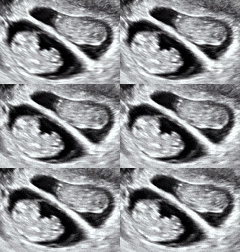 Dichorionic twins with heart activity at 8w5d since co-incubation

Sponsored Health Resource

W8MD Weight Loss, Sleep & MedSpa
Looking for physician-supervised weight loss, semaglutide, tirzepatide, or GLP-1 receptor agonist options? W8MD helps eligible patients in New York City, Brooklyn, New Jersey, Connecticut, Pennsylvania, Delaware, and greater Philadelphia with medical weight loss, sleep medicine, and long-term maintenance support.
GLP-1 specials: Affordable GLP-1 injections NYC and Philadelphia starting from $29.99/week and up for semaglutide with insurance accepted for qualifying visits, and $45/week and up for tirzepatide with insurance accepted for qualifying visits. Self-pay options start from $59.99/week and up for semaglutide and $69.99/week and up for tirzepatide.
- Medical weight loss NYC
- Affordable GLP-1 injections NYC
- Budget GLP-1 weight loss shots Philadelphia
- New Jersey medical weight loss
- NYC medical weight loss blog
- Philadelphia weight loss blog
- Sleep medicine and sleep apnea services
- W8MD MedSpa and wellness
Book a W8MD appointment · View GLP-1 specials
Paid promotional message. Eligibility, pricing, insurance coverage, medication availability, and results vary. Medical evaluation required.

Medical Disclaimer: WikiMD is for informational purposes only and is not a substitute for professional medical advice. Content may be inaccurate or outdated and should not be used for diagnosis or treatment. Always consult your healthcare provider for medical decisions. Verify information with trusted sources such as CDC.gov and NIH.gov. By using this site, you agree that WikiMD is not liable for any outcomes related to its content. See full disclaimer.
Credits:Most images are courtesy of Wikimedia commons, and templates, categories Wikipedia, licensed under CC BY SA or similar.
Translate page: - East Asian
中文,
日本,
한국어,
South Asian
हिन्दी,
தமிழ்,
తెలుగు,
Urdu,
ಕನ್ನಡ,
Southeast Asian
Indonesian,
Vietnamese,
Thai,
မြန်မာဘာသာ,
বাংলা
European
español,
Deutsch,
français,
Greek,
português do Brasil,
polski,
română,
русский,
Nederlands,
norsk,
svenska,
suomi,
Italian
Middle Eastern & African
عربى,
Turkish,
Persian,
Hebrew,
Afrikaans,
isiZulu,
Kiswahili,
Other
Bulgarian,
Hungarian,
Czech,
Swedish,
മലയാളം,
मराठी,
ਪੰਜਾਬੀ,
ગુજરાતી,
Portuguese,
Ukrainian

