Dynamic hip screw
Dynamic Hip Screw (DHS) is a type of orthopedic implant designed for the fixation of certain types of hip fractures. The design allows controlled dynamic sliding of the femoral head component along the construct.
Indications[edit]
The Dynamic Hip Screw is designed to provide strong and stable internal fixation of a variety of intertrochanteric, subtrochanteric and basilar neck fractures, with minimal soft tissue irritation.
Design[edit]
The DHS system consists of a lag screw (or "hip screw"), inserted into the neck and head of the femur, and a side plate, which is fixed to the proximal lateral surface of the femur.
Procedure[edit]
The procedure to implant the DHS involves a surgical operation. The patient is placed in a supine position and the hip is exposed through a lateral incision. The lag screw is inserted into the femoral head and the side plate is attached to the lateral surface of the femur. The plate is fixed to the bone with cortical and cancellous bone screws.
Complications[edit]
Possible complications of the procedure include non-union, mal-union, infection, implant failure, and avascular necrosis of the femoral head.
See also[edit]
References[edit]

This WikiMD article can only be edited by registered and verified editors. You can log in or register.
-
 Dynamic hip screw hardware
 -
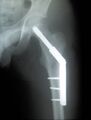 Dynamic hip implant
 -
 Dr. G.J. Mulder


Medical Disclaimer: WikiMD is for informational purposes only and is not a substitute for professional medical advice. Content may be inaccurate or outdated and should not be used for diagnosis or treatment. Always consult your healthcare provider for medical decisions. Verify information with trusted sources such as CDC.gov and NIH.gov. By using this site, you agree that WikiMD is not liable for any outcomes related to its content. See full disclaimer.
Credits:Most images are courtesy of Wikimedia commons, and templates, categories Wikipedia, licensed under CC BY SA or similar.
Translate page: - East Asian
中文,
日本,
한국어,
South Asian
हिन्दी,
தமிழ்,
తెలుగు,
Urdu,
ಕನ್ನಡ,
Southeast Asian
Indonesian,
Vietnamese,
Thai,
မြန်မာဘာသာ,
বাংলা
European
español,
Deutsch,
français,
Greek,
português do Brasil,
polski,
română,
русский,
Nederlands,
norsk,
svenska,
suomi,
Italian
Middle Eastern & African
عربى,
Turkish,
Persian,
Hebrew,
Afrikaans,
isiZulu,
Kiswahili,
Other
Bulgarian,
Hungarian,
Czech,
Swedish,
മലയാളം,
मराठी,
ਪੰਜਾਬੀ,
ગુજરાતી,
Portuguese,
Ukrainian

