Poultry farming
Poultry farming is the agricultural practice of breeding and raising domesticated birds such as chickens, ducks, turkeys, and geese to produce meat or eggs for human consumption. It is a critical component of the global agriculture sector, providing a significant source of protein to populations worldwide. This article delves into the various aspects of poultry farming, including its history, methods, challenges, and impacts on society.
History[edit]
Poultry farming dates back thousands of years. Domestication of birds for food production is believed to have occurred in Southeast Asia around 7400 BC, with chickens being introduced to other parts of the world over the following millennia. The practice has evolved significantly since its inception, from small backyard flocks to large-scale commercial operations.
Types of Poultry Farming[edit]
Poultry farming can be categorized into two main types: Layer farming and Broiler farming.
Layer Farming[edit]
Layer farming is focused on raising chickens for egg production. Hens are kept for around one to two years, during which time they lay eggs. These operations can vary in size from small-scale backyard coops to large commercial farms with tens of thousands of birds.
Broiler Farming[edit]
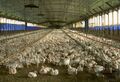
Broiler farming is concerned with raising chickens for meat. These chickens are bred to grow quickly, reaching slaughter weight in about six to seven weeks. Like layer farming, broiler production can range from small to large-scale operations.
Housing and Environment[edit]
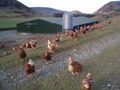
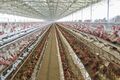
Proper housing and environmental control are crucial for the health and productivity of poultry. Common housing systems include free-range, battery cages, aviaries, and barn systems. Each system has its advantages and disadvantages in terms of animal welfare, disease control, and environmental impact.
Feeding[edit]
Feeding constitutes a significant portion of the operational costs in poultry farming. Diets are formulated based on the nutritional needs of the birds, which vary between layers and broilers. Feed is typically composed of grains, protein sources, and supplements to promote health and productivity.
Health Management[edit]
Maintaining the health of poultry flocks is essential for successful farming. This includes regular vaccination, parasite control, and monitoring for signs of illness. Biosecurity measures are also critical to prevent the introduction and spread of diseases.
Challenges[edit]
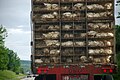
Poultry farming faces several challenges, including disease outbreaks, environmental concerns, and ethical issues related to animal welfare. Avian influenza, for example, is a significant threat that can lead to large-scale culling of birds and economic losses.
Environmental Impact[edit]
Poultry farming has environmental impacts, including greenhouse gas emissions, water pollution, and use of resources. Sustainable practices, such as improved waste management and energy-efficient operations, are being implemented to mitigate these effects.
Ethical Considerations[edit]
Animal welfare is a growing concern in poultry farming. Critics argue that many commercial farming practices, such as the use of battery cages, do not provide adequate space or enrichment for the birds. There is a trend towards more humane practices, including the adoption of free-range systems and enhancements to living conditions.
Conclusion[edit]
Poultry farming plays a vital role in meeting the world's demand for protein. While it offers economic benefits, it also poses challenges that require careful management and sustainable practices to ensure the welfare of the birds and minimize environmental impacts.
 | This agriculture article is a stub. You can help WikiMD by expanding the page. |
-
 Poultry_farming
 -
 Poultry_farming
 -
 Poultry_farming
 -
 Poultry_farming
 -
 Poultry_farming
 -
 Poultry_farming
 -
 Poultry_farming
 -
 Poultry_farming
 -
 Poultry_farming
 -
 Poultry_farming
 -
 Poultry_farming
 -
 Poultry_farming


Sponsored Health Resource

W8MD Weight Loss, Sleep & MedSpa
Looking for physician-supervised weight loss, semaglutide, tirzepatide, or GLP-1 receptor agonist options? W8MD helps eligible patients in New York City, Brooklyn, New Jersey, Connecticut, Pennsylvania, Delaware, and greater Philadelphia with medical weight loss, sleep medicine, and long-term maintenance support.
GLP-1 specials: Affordable GLP-1 injections NYC and Philadelphia starting from $29.99/week and up for semaglutide with insurance accepted for qualifying visits, and $45/week and up for tirzepatide with insurance accepted for qualifying visits. Self-pay options start from $59.99/week and up for semaglutide and $69.99/week and up for tirzepatide.
Medical weight loss NYC | Affordable GLP-1 injections NYC | Budget GLP-1 weight loss shots Philadelphia | New Jersey medical weight loss | NYC medical weight loss | Philadelphia medical weight loss | Sleep clinic NYC | W8MD's Philadelphia GLP-1 doctor | Weight loss prescriptions NYC
Book a W8MD appointment · View GLP-1 specials
Paid promotional message. Eligibility, pricing, insurance coverage, medication availability, and results vary. Medical evaluation required.

Medical Disclaimer: WikiMD is for informational purposes only and is not a substitute for professional medical advice. Content may be inaccurate or outdated and should not be used for diagnosis or treatment. Always consult your healthcare provider for medical decisions. Verify information with trusted sources such as CDC.gov and NIH.gov. By using this site, you agree that WikiMD is not liable for any outcomes related to its content. See full disclaimer.
Credits:Most images are courtesy of Wikimedia commons, and templates, categories Wikipedia, licensed under CC BY SA or similar.
Translate page: - East Asian
中文,
日本,
한국어,
South Asian
हिन्दी,
தமிழ்,
తెలుగు,
Urdu,
ಕನ್ನಡ,
Southeast Asian
Indonesian,
Vietnamese,
Thai,
မြန်မာဘာသာ,
বাংলা
European
español,
Deutsch,
français,
Greek,
português do Brasil,
polski,
română,
русский,
Nederlands,
norsk,
svenska,
suomi,
Italian
Middle Eastern & African
عربى,
Turkish,
Persian,
Hebrew,
Afrikaans,
isiZulu,
Kiswahili,
Other
Bulgarian,
Hungarian,
Czech,
Swedish,
മലയാളം,
मराठी,
ਪੰਜਾਬੀ,
ગુજરાતી,
Portuguese,
Ukrainian

