Driver's license
Driver's License is an official document permitting a specific individual to operate one or more types of motorized vehicles, such as a motorcycle, car, truck, or bus on a public road. The laws relating to the licensing of drivers vary between countries. In most areas, a driver's license is issued by the government authority after the applicant has passed a driving test, along with tests of eyesight and recognition of road signs. Driver's licenses are typically plastic and the size of a credit card, featuring the holder's name, photograph, and other information.
History[edit]
The first laws requiring the certification of motor vehicle operators originated in Germany in 1903. France, Italy, and other European countries followed suit. In the United States, the first state to require a driver's license was New York in 1901, although at that time, the license did not require a test of driving ability.
Types of Licenses[edit]
Different categories of driver's licenses are issued for the various types of vehicles. For example:
- Class A, typically for heavy trucks with trailers
- Class B, for straight trucks
- Class C, for designed vehicles carrying 16 or more passengers (including the driver) or hazardous materials
- Motorcycle licenses, specifically for motorcycles
International Driving Permits (IDP) allow citizens of a country to drive in another country without further tests or applications, provided their domestic driver's licenses are valid.
Requirements for Obtaining a License[edit]
The requirements for obtaining a driver's license vary but generally include a minimum age, a written test on the rules of the road, and a driving test. Some jurisdictions require a period of supervised driving before a new driver can obtain a full license.
Renewal and Suspension[edit]
Driver's licenses are typically valid for a set period; a renewal test may be required for renewal. Licenses can be suspended or revoked for various reasons, such as driving under the influence of alcohol or drugs, accumulating too many penalty points through violations, or medical reasons.
Digital Driver's Licenses[edit]
Some regions are moving towards digital driver's licenses, which are stored on a smartphone app. These digital licenses are designed to be more convenient and secure, offering features such as privacy controls and fraud protection.
Legal Implications[edit]
Holding a driver's license comes with legal responsibilities. Drivers are required to follow the road laws of the country or region in which they are driving. Failure to adhere to these laws can result in penalties, including fines, points on the driver's license, and even imprisonment.
International Considerations[edit]
While many countries recognize driver's licenses issued by other nations, some require foreign drivers to carry an International Driving Permit. An IDP is a translation of a driver's existing license and is used in conjunction with the domestic license.
See Also[edit]
 | This article about transport is a stub. You can help WikiMD by expanding the page. |
Driver's_license[edit]
-
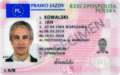 Driving licence Poland 2013 recto
 -
 Driving licence Poland 2013 verso
 -
 Karl Benz Führerschein
 -
 UN Geneva convention driver permit color
 -
 James Webb lunar drivers license
 -
 Fahrerlaubnisklassen
 -
 SIM Indonesia Sample
 -
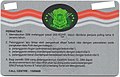 Back Side of the Indonesian Driving License
 -
 Iclicense
 -
 DE Licence 2013 Front
 -
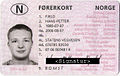 Førerkort fremside
 -
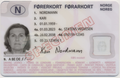 Norway driving licence front (2022)


.png)

Medical Disclaimer: WikiMD is for informational purposes only and is not a substitute for professional medical advice. Content may be inaccurate or outdated and should not be used for diagnosis or treatment. Always consult your healthcare provider for medical decisions. Verify information with trusted sources such as CDC.gov and NIH.gov. By using this site, you agree that WikiMD is not liable for any outcomes related to its content. See full disclaimer.
Credits:Most images are courtesy of Wikimedia commons, and templates, categories Wikipedia, licensed under CC BY SA or similar.
Translate page: - East Asian
中文,
日本,
한국어,
South Asian
हिन्दी,
தமிழ்,
తెలుగు,
Urdu,
ಕನ್ನಡ,
Southeast Asian
Indonesian,
Vietnamese,
Thai,
မြန်မာဘာသာ,
বাংলা
European
español,
Deutsch,
français,
Greek,
português do Brasil,
polski,
română,
русский,
Nederlands,
norsk,
svenska,
suomi,
Italian
Middle Eastern & African
عربى,
Turkish,
Persian,
Hebrew,
Afrikaans,
isiZulu,
Kiswahili,
Other
Bulgarian,
Hungarian,
Czech,
Swedish,
മലയാളം,
मराठी,
ਪੰਜਾਬੀ,
ગુજરાતી,
Portuguese,
Ukrainian

