Diving shot
Diving shot is a term used in various sports, including water polo, soccer, and basketball, to describe a specific type of shot or move. In water polo, a diving shot is a shot taken while the player is in mid-air, having dived off from the side of the pool. In soccer, a diving shot often refers to a header or volley struck while the player is in a diving position. In basketball, a diving shot can refer to a layup or dunk attempt made while the player is in mid-air, having jumped or dived towards the basket.
Water Polo[edit]
In water polo, a diving shot is a shot taken while the player is in mid-air, having dived off from the side of the pool. This type of shot requires a high degree of skill and athleticism, as the player must accurately aim and release the ball while in mid-air and before hitting the water. The diving shot is often used in situations where the player needs to get a shot off quickly, before the defense can react.
Soccer[edit]
In soccer, a diving shot often refers to a header or volley struck while the player is in a diving position. This is often seen when a player dives forward to meet a cross or pass with their head, directing the ball towards the goal. A diving shot can also refer to a volley struck while the player is in mid-air, having dived to meet the ball. This type of shot requires excellent timing and body control, as well as accuracy to direct the ball on target.
Basketball[edit]
In basketball, a diving shot can refer to a layup or dunk attempt made while the player is in mid-air, having jumped or dived towards the basket. This type of shot is often seen in fast-break situations, where the player is attempting to score before the defense can set up. The diving shot in basketball requires good body control and accuracy, as the player must guide the ball into the basket while in mid-air.
See Also[edit]
 | This sports-related article is a stub. You can help WikiMD by expanding the page. |
Diving_shot[edit]
-
 Buoy and reel for diving shotline deployed
 -
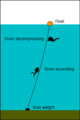 Divers ascending at shotline
 -
Shotline bottom tensioned
-
Shotline top tensioned
-
Shotline lazy shot
-
Shotline with deco trapeze
-
Shotline with spar buoy in series
-
Shotline and reel


Medical Disclaimer: WikiMD is for informational purposes only and is not a substitute for professional medical advice. Content may be inaccurate or outdated and should not be used for diagnosis or treatment. Always consult your healthcare provider for medical decisions. Verify information with trusted sources such as CDC.gov and NIH.gov. By using this site, you agree that WikiMD is not liable for any outcomes related to its content. See full disclaimer.
Credits:Most images are courtesy of Wikimedia commons, and templates, categories Wikipedia, licensed under CC BY SA or similar.
Translate page: - East Asian
中文,
日本,
한국어,
South Asian
हिन्दी,
தமிழ்,
తెలుగు,
Urdu,
ಕನ್ನಡ,
Southeast Asian
Indonesian,
Vietnamese,
Thai,
မြန်မာဘာသာ,
বাংলা
European
español,
Deutsch,
français,
Greek,
português do Brasil,
polski,
română,
русский,
Nederlands,
norsk,
svenska,
suomi,
Italian
Middle Eastern & African
عربى,
Turkish,
Persian,
Hebrew,
Afrikaans,
isiZulu,
Kiswahili,
Other
Bulgarian,
Hungarian,
Czech,
Swedish,
മലയാളം,
मराठी,
ਪੰਜਾਬੀ,
ગુજરાતી,
Portuguese,
Ukrainian


