Dinoflagellate
Dinoflagellates are a large group of flagellate protists. They constitute the phylum Dinoflagellata, which is classified under the supergroup Alveolata. Dinoflagellates are important components of the aquatic ecosystems and play a crucial role in the production of oxygen and the food chain.
Characteristics[edit]
Dinoflagellates are unicellular and possess two dissimilar flagella arising from the ventral cell side (the dinokont flagellation). They have a unique nuclear structure (the dinokaryon), and they exhibit diverse nutritional strategies including photosynthesis, predation, parasitism, and symbiosis.
Ecology[edit]
Dinoflagellates can be found in all aquatic environments: in freshwater, marine, and brackish habitats. They are a major component of plankton. Some species are bioluminescent and can illuminate the water at night.
Human Impact[edit]
Some dinoflagellates produce toxins that are harmful to humans and animals. These toxins can accumulate in shellfish, leading to shellfish poisoning when consumed. Dinoflagellates are also responsible for the red tide phenomenon.
Classification[edit]
Dinoflagellates are classified under the supergroup Alveolata, together with ciliates and apicomplexans. The phylum Dinoflagellata includes about 2,000 living species.
See Also[edit]
 | This medical article is a stub. You can help WikiMD by expanding the page. |
-
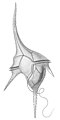 Ceratium hirundinella
 -
 2023 Dinoflagellate
 -
 Britannica Dinoflagellata 2
 -
 Динофитовая микроводоросль, выделенная из осадков Амурского залива в 2020 году
 -
 Algal bloom (akasio) by Noctiluca in Nagasaki
 -
 Noctiluca scintillans
 -
 Kayaking in the Bioluminescent Bay Vieques
 -
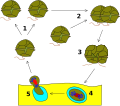 Dinoflagellata Life Cycle
 -
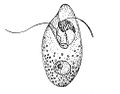 Oxyrrhis marina


_by_Noctiluca_in_Nagasaki.jpg)


Medical Disclaimer: WikiMD is for informational purposes only and is not a substitute for professional medical advice. Content may be inaccurate or outdated and should not be used for diagnosis or treatment. Always consult your healthcare provider for medical decisions. Verify information with trusted sources such as CDC.gov and NIH.gov. By using this site, you agree that WikiMD is not liable for any outcomes related to its content. See full disclaimer.
Credits:Most images are courtesy of Wikimedia commons, and templates, categories Wikipedia, licensed under CC BY SA or similar.
Translate this page: - East Asian
中文,
日本,
한국어,
South Asian
हिन्दी,
தமிழ்,
తెలుగు,
Urdu,
ಕನ್ನಡ,
Southeast Asian
Indonesian,
Vietnamese,
Thai,
မြန်မာဘာသာ,
বাংলা
European
español,
Deutsch,
français,
Greek,
português do Brasil,
polski,
română,
русский,
Nederlands,
norsk,
svenska,
suomi,
Italian
Middle Eastern & African
عربى,
Turkish,
Persian,
Hebrew,
Afrikaans,
isiZulu,
Kiswahili,
Other
Bulgarian,
Hungarian,
Czech,
Swedish,
മലയാളം,
मराठी,
ਪੰਜਾਬੀ,
ગુજરાતી,
Portuguese,
Ukrainian
