Delos
Delos[edit]
Delos is a small Greek island in the Aegean Sea, which holds great historical and mythological significance. It is part of the Cyclades archipelago and is renowned for its archaeological sites and ancient ruins. Delos is considered one of the most important mythological, historical, and archaeological sites in Greece.
Geography[edit]
Delos is located near the center of the Cyclades archipelago, southwest of Mykonos. The island is relatively small, with an area of about 3.4 square kilometers. Despite its size, Delos has a rich history and was once a bustling center of trade and culture.
Mythological Significance[edit]
According to Greek mythology, Delos is the birthplace of the twin gods Apollo and Artemis. The island was considered sacred, and it was forbidden for anyone to be born or to die on the island. This mythological significance made Delos a major religious center in ancient Greece.
Historical Background[edit]
Delos has been inhabited since the 3rd millennium BCE. During the 1st millennium BCE, it became a major religious and commercial hub. The island was a center for the worship of Apollo, and it hosted the Delian League, an association of Greek city-states led by Athens.
The Delian League[edit]
The Delian League was established in 478 BCE as a coalition of Greek city-states to defend against Persian aggression. Delos was chosen as the meeting place and treasury of the League due to its central location and religious significance.
Archaeological Significance[edit]
Delos is home to a vast array of ancient ruins, including temples, statues, and marketplaces. The archaeological site of Delos is a UNESCO World Heritage Site, recognized for its historical and cultural importance.
Notable Structures[edit]
- The Temple of Apollo: A major sanctuary dedicated to Apollo, featuring several temples and altars.
- The Terrace of the Lions: A row of marble lion statues dedicated to Apollo by the people of Naxos.
- The House of Dionysus: A well-preserved private house known for its intricate mosaics.
Modern Day Delos[edit]
Today, Delos is uninhabited, but it remains a popular tourist destination. Visitors can explore the extensive ruins and learn about the island's rich history. Access to Delos is typically via boat from nearby islands such as Mykonos.
See Also[edit]
References[edit]
External Links[edit]
-
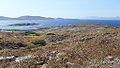 Delos
Delos -
 Delos
Delos -
 Ancient Greek theatre in Delos
 -
 Agora of the Compitaliasten, Delos
 -
 Terrace of the Lions, Delos
 -
 House of Dionysos, Delos
 -
 Theatre Quarter, Delos
 -
 Sacred Way, Delos
 -
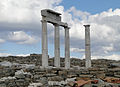 Establishment of the Poseidoniasts, Delos
 -
 House of Dionysus floor mosaic, Delos
 -
 House of the Masks, Delos
 -
 House of Cleopatra, Delos


Medical Disclaimer: WikiMD is for informational purposes only and is not a substitute for professional medical advice. Content may be inaccurate or outdated and should not be used for diagnosis or treatment. Always consult your healthcare provider for medical decisions. Verify information with trusted sources such as CDC.gov and NIH.gov. By using this site, you agree that WikiMD is not liable for any outcomes related to its content. See full disclaimer.
Credits:Most images are courtesy of Wikimedia commons, and templates, categories Wikipedia, licensed under CC BY SA or similar.
Translate this page: - East Asian
中文,
日本,
한국어,
South Asian
हिन्दी,
தமிழ்,
తెలుగు,
Urdu,
ಕನ್ನಡ,
Southeast Asian
Indonesian,
Vietnamese,
Thai,
မြန်မာဘာသာ,
বাংলা
European
español,
Deutsch,
français,
Greek,
português do Brasil,
polski,
română,
русский,
Nederlands,
norsk,
svenska,
suomi,
Italian
Middle Eastern & African
عربى,
Turkish,
Persian,
Hebrew,
Afrikaans,
isiZulu,
Kiswahili,
Other
Bulgarian,
Hungarian,
Czech,
Swedish,
മലയാളം,
मराठी,
ਪੰਜਾਬੀ,
ગુજરાતી,
Portuguese,
Ukrainian

