Deep palmar arch
The Deep Palmar Arch is a component of the human anatomy specifically found in the hand. It is an arterial structure that is primarily formed by the radial artery, with a contribution from the deep branch of the ulnar artery. The deep palmar arch is located deeper in the palm compared to the superficial palmar arch.
Etymology[edit]
The term "Deep Palmar Arch" is derived from its anatomical location and structure. "Deep" refers to its position in the palm, "Palmar" pertains to the palm of the hand, and "Arch" describes its curved, bow-like shape.
Anatomy[edit]
The deep palmar arch is located deep in the palm, proximal to the metacarpal bones. It is primarily formed by the radial artery, which enters the hand dorsally and travels through the anatomical snuffbox, and the deep branch of the ulnar artery. The arch gives rise to the palmar metacarpal arteries which supply the metacarpals and digits.
Clinical Significance[edit]
The deep palmar arch, along with the superficial palmar arch, plays a crucial role in the blood supply to the hand. Any injury or obstruction to these arches can lead to serious complications, including ischemia and necrosis. Conditions such as Raynaud's disease or Buerger's disease can also affect the deep palmar arch.
Related Terms[edit]
- Superficial palmar arch: An arterial structure in the hand that is more superficial compared to the deep palmar arch.
- Radial artery: A major artery in the forearm that primarily forms the deep palmar arch.
- Deep branch of the ulnar artery: An artery that contributes to the formation of the deep palmar arch.
- Palmar metacarpal arteries: Arteries that arise from the deep palmar arch and supply the metacarpals and digits.

This WikiMD article can only be edited by registered and verified editors. You can log in or register.
-
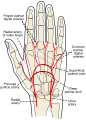 Deep palmar arch illustration from Gray's Anatomy
 -
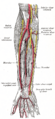 Deep palmar arch and surrounding structures
 -
Deep palmar arch dissection slide
-
Deep palmar arch anatomical slide


Medical Disclaimer: WikiMD is for informational purposes only and is not a substitute for professional medical advice. Content may be inaccurate or outdated and should not be used for diagnosis or treatment. Always consult your healthcare provider for medical decisions. Verify information with trusted sources such as CDC.gov and NIH.gov. By using this site, you agree that WikiMD is not liable for any outcomes related to its content. See full disclaimer.
Credits:Most images are courtesy of Wikimedia commons, and templates, categories Wikipedia, licensed under CC BY SA or similar.
Translate page: - East Asian
中文,
日本,
한국어,
South Asian
हिन्दी,
தமிழ்,
తెలుగు,
Urdu,
ಕನ್ನಡ,
Southeast Asian
Indonesian,
Vietnamese,
Thai,
မြန်မာဘာသာ,
বাংলা
European
español,
Deutsch,
français,
Greek,
português do Brasil,
polski,
română,
русский,
Nederlands,
norsk,
svenska,
suomi,
Italian
Middle Eastern & African
عربى,
Turkish,
Persian,
Hebrew,
Afrikaans,
isiZulu,
Kiswahili,
Other
Bulgarian,
Hungarian,
Czech,
Swedish,
മലയാളം,
मराठी,
ਪੰਜਾਬੀ,
ગુજરાતી,
Portuguese,
Ukrainian


