Dante Alighieri
Dante Alighieri (1265–1321) was an Italian poet, writer, and philosopher. His most famous work, the Divine Comedy, is considered one of the greatest literary works in the Italian language and the Western literary tradition.
Life[edit]
Dante was born in Florence, Italy, in 1265. His family was of moderate wealth and political influence, and he was educated in the classics and philosophy. He began writing poetry in his teens and became involved in the complex politics of Florence in his twenties.
Works[edit]
Dante's most famous work is the Divine Comedy, an epic poem in three parts: Inferno, Purgatorio, and Paradiso. The poem is an allegorical journey through Hell, Purgatory, and Heaven, and is considered a masterpiece of world literature.
Dante also wrote other works, including La Vita Nuova (The New Life), a collection of love poems, and De Monarchia, a treatise on political philosophy.
Legacy[edit]
Dante's influence on literature and culture is immense. His works have been translated into many languages and have inspired countless writers, artists, and thinkers. He is often referred to as "the father of the Italian language" because his works helped to establish the Tuscan dialect as the standard for Italian.
See also[edit]
References[edit]
External links[edit]

This WikiMD article can only be edited by registered and verified editors. You can log in or register.
-
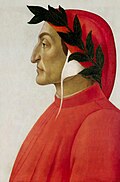 Dante Alighieri
 -
 Dante Alighieri
 -
 Dante Alighieri
 -
 Dante Alighieri
 -
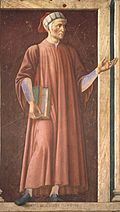 Dante Alighieri
 -
 Dante Alighieri
 -
 Dante Alighieri
 -
 Dante Alighieri
 -
 Dante Alighieri
 -
 Dante Alighieri
 -
 Dante Alighieri
 -
 Dante Alighieri


.jpg)


.jpg)
_-_Facade.jpg)
Advertise on WikiMD — 81,000+ full articles, ~900,000 total pages, ~250 million page views. Global reach, limited time promotional rates from $1/page/day. Learn more · View stats


Translate page: - East Asian
中文,
日本,
한국어,
South Asian
हिन्दी,
தமிழ்,
తెలుగు,
Urdu,
ಕನ್ನಡ,
Southeast Asian
Indonesian,
Vietnamese,
Thai,
မြန်မာဘာသာ,
বাংলা
European
español,
Deutsch,
français,
Greek,
português do Brasil,
polski,
română,
русский,
Nederlands,
norsk,
svenska,
suomi,
Italian
Middle Eastern & African
عربى,
Turkish,
Persian,
Hebrew,
Afrikaans,
isiZulu,
Kiswahili,
Other
Bulgarian,
Hungarian,
Czech,
Swedish,
മലയാളം,
मराठी,
ਪੰਜਾਬੀ,
ગુજરાતી,
Portuguese,
Ukrainian
About WikiMD • Contact • Disclaimer • Privacy • Copyright • Site statistics
Some content and images may originate from Wikimedia Commons or Wikipedia and remain subject to their stated licenses. Unless otherwise noted, eligible WikiMD content is available under CC BY-SA 4.0.
WikiMD Wellnesspedia — Free health & wellness information for patients, students, and health professionals.

