Taraxacum
Article about the genus Taraxacum
Taraxacum is a large genus of flowering plants in the family Asteraceae, which consists of species commonly known as dandelions. The genus is native to Eurasia and North America, but the two most common species worldwide, Taraxacum officinale and Taraxacum erythrospermum, were introduced from Europe and now propagate as wildflowers.
Description[edit]
Taraxacum species are perennial, herbaceous plants that grow from a taproot. They have a rosette of leaves at the base and produce bright yellow flowers. The leaves are deeply lobed and can vary in shape and size. The flowers are composite, consisting of numerous small florets. After flowering, the plant produces a spherical seed head, often referred to as a "dandelion clock," which is composed of many single-seeded fruits called achenes. Each achene is attached to a pappus of fine hairs, which allows it to be carried by the wind.

Ecology[edit]
Taraxacum species are adapted to a wide range of environments and are often found in disturbed habitats such as lawns, roadsides, and fields. They are important early spring nectar sources for pollinators such as bees and butterflies. The seeds are dispersed by wind, which allows them to colonize new areas rapidly.
Uses[edit]
Taraxacum has been used in traditional medicine for centuries. The leaves, flowers, and roots are all edible and have been used in salads, teas, and as a coffee substitute. The plant is rich in vitamins A, C, and K, and contains minerals such as iron, calcium, and potassium.
Medicinal Uses[edit]
Traditionally, dandelion has been used to treat liver disorders, improve digestion, and as a diuretic. Modern research is investigating its potential anti-inflammatory and antioxidant properties. However, more scientific studies are needed to confirm these health benefits.
Culinary Uses[edit]
The young leaves of Taraxacum can be eaten raw in salads or cooked like spinach. The flowers can be used to make dandelion wine, and the roots can be roasted and ground to make a caffeine-free coffee substitute.

Cultivation[edit]
While often considered a weed, Taraxacum can be cultivated for its edible and medicinal properties. It prefers well-drained soil and full sun but can tolerate partial shade. Regular harvesting of leaves and flowers can prevent the plant from becoming invasive in garden settings.
Also see[edit]

Template:Asteraceae Template:Herbs
Taraxacum[edit]
-
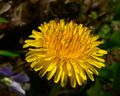 Dandelion Flower
 -
Taraxacum Officinale Seed
-
 Floating
 -
Желтое море
-
HAWKBEARD
-
Dandelion Seedhead with Only a Single Seed Still Attached
-
T albidum
-
Taraxacum californicum
-
T japonicum


Medical Disclaimer: WikiMD is for informational purposes only and is not a substitute for professional medical advice. Content may be inaccurate or outdated and should not be used for diagnosis or treatment. Always consult your healthcare provider for medical decisions. Verify information with trusted sources such as CDC.gov and NIH.gov. By using this site, you agree that WikiMD is not liable for any outcomes related to its content. See full disclaimer.
Credits:Most images are courtesy of Wikimedia commons, and templates, categories Wikipedia, licensed under CC BY SA or similar.
Translate page: - East Asian
中文,
日本,
한국어,
South Asian
हिन्दी,
தமிழ்,
తెలుగు,
Urdu,
ಕನ್ನಡ,
Southeast Asian
Indonesian,
Vietnamese,
Thai,
မြန်မာဘာသာ,
বাংলা
European
español,
Deutsch,
français,
Greek,
português do Brasil,
polski,
română,
русский,
Nederlands,
norsk,
svenska,
suomi,
Italian
Middle Eastern & African
عربى,
Turkish,
Persian,
Hebrew,
Afrikaans,
isiZulu,
Kiswahili,
Other
Bulgarian,
Hungarian,
Czech,
Swedish,
മലയാളം,
मराठी,
ਪੰਜਾਬੀ,
ગુજરાતી,
Portuguese,
Ukrainian


