Cytokeratin
Cytokeratin is a type of keratin that is found in the intracytoplasmic cytoskeleton of epithelial tissue. It plays a vital role in maintaining the overall structural integrity of epithelial cells and also functions in several types of cell movements, including those involved in wound healing and tissue repair.
Structure[edit]
Cytokeratins are a subfamily of intermediate filaments and are characterized by their diversity and cell type-specific expression patterns. They are divided into two types: Type I, the acidic cytokeratins, and Type II, the basic to neutral cytokeratins. Each epithelial cell type expresses a specific combination of Type I and Type II cytokeratins, which helps in the identification of different types of epithelial tissues under the microscope.
Function[edit]
Cytokeratins play a crucial role in mechanical support and cytoplasm organization in epithelial cells. They also participate in cell signaling and protect epithelial tissues from damage. In addition, cytokeratins are involved in cell movement, particularly during wound healing and tissue repair.
Clinical significance[edit]
Cytokeratins are often used in diagnostic pathology as markers of epithelial differentiation. They can be detected in tissue samples using immunohistochemistry, which can help in the diagnosis of various types of cancers, including carcinomas. In addition, changes in the expression or organization of cytokeratins can indicate pathological conditions such as cancer and epidermolysis bullosa, a group of genetic conditions that cause the skin to be very fragile and to blister easily.
See also[edit]
References[edit]

This WikiMD article can only be edited by registered and verified editors. You can log in or register.
Cytokeratin[edit]
-
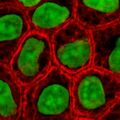 Epithelial cells
 -
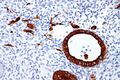 Intermediate trophoblast - LMWK - high magnification
 -
Cytokeratin filaments


Medical Disclaimer: WikiMD is for informational purposes only and is not a substitute for professional medical advice. Content may be inaccurate or outdated and should not be used for diagnosis or treatment. Always consult your healthcare provider for medical decisions. Verify information with trusted sources such as CDC.gov and NIH.gov. By using this site, you agree that WikiMD is not liable for any outcomes related to its content. See full disclaimer.
Credits:Most images are courtesy of Wikimedia commons, and templates, categories Wikipedia, licensed under CC BY SA or similar.
Translate page: - East Asian
中文,
日本,
한국어,
South Asian
हिन्दी,
தமிழ்,
తెలుగు,
Urdu,
ಕನ್ನಡ,
Southeast Asian
Indonesian,
Vietnamese,
Thai,
မြန်မာဘာသာ,
বাংলা
European
español,
Deutsch,
français,
Greek,
português do Brasil,
polski,
română,
русский,
Nederlands,
norsk,
svenska,
suomi,
Italian
Middle Eastern & African
عربى,
Turkish,
Persian,
Hebrew,
Afrikaans,
isiZulu,
Kiswahili,
Other
Bulgarian,
Hungarian,
Czech,
Swedish,
മലയാളം,
मराठी,
ਪੰਜਾਬੀ,
ગુજરાતી,
Portuguese,
Ukrainian


