Cutaneous innervation of the upper limbs
Overview of the nerve supply to the skin of the upper limbs
The cutaneous innervation of the upper limbs refers to the distribution of sensory nerves that supply the skin of the upper limbs, including the shoulder, arm, forearm, and hand. These nerves are responsible for transmitting sensory information such as touch, pain, temperature, and proprioception from the skin to the central nervous system.
Overview[edit]
The cutaneous innervation of the upper limbs is primarily provided by the brachial plexus, a network of nerves that originates from the spinal cord in the neck region. The brachial plexus gives rise to several major nerves that supply both motor and sensory innervation to the upper limbs. The sensory branches of these nerves are responsible for the cutaneous innervation.
Major Nerves and Their Cutaneous Branches[edit]
Axillary Nerve[edit]
The axillary nerve arises from the posterior cord of the brachial plexus and provides cutaneous innervation to the skin over the deltoid muscle and the lateral aspect of the shoulder. The sensory branch responsible for this is the superior lateral cutaneous nerve of the arm.
Radial Nerve[edit]
The radial nerve is a major nerve of the upper limb that supplies the posterior aspect of the arm and forearm. Its cutaneous branches include:
- The posterior cutaneous nerve of the arm, which supplies the skin on the posterior surface of the arm.
- The posterior cutaneous nerve of the forearm, which supplies the skin on the posterior surface of the forearm.
- The superficial branch of the radial nerve, which supplies the skin on the dorsal aspect of the hand and the dorsal surfaces of the lateral three and a half fingers, excluding the fingertips.
Musculocutaneous Nerve[edit]
The musculocutaneous nerve provides motor innervation to the anterior compartment of the arm and gives rise to the lateral cutaneous nerve of the forearm, which supplies the skin on the lateral aspect of the forearm.
Median Nerve[edit]
The median nerve is responsible for the cutaneous innervation of the palmar aspect of the lateral three and a half fingers and the corresponding area of the palm. It also supplies the fingertips of these fingers on the dorsal side.
Ulnar Nerve[edit]
The ulnar nerve supplies the skin on the palmar and dorsal aspects of the medial one and a half fingers and the corresponding area of the palm and dorsum of the hand.
Dermatomes[edit]
The skin of the upper limbs is divided into specific areas known as dermatomes, each of which is innervated by a single spinal nerve root. The dermatomes of the upper limb are organized in a pattern that reflects the embryological development of the limb. Key dermatomes include:
- C5: Lateral aspect of the arm
- C6: Lateral aspect of the forearm and thumb
- C7: Middle finger
- C8: Little finger and medial aspect of the hand
- T1: Medial aspect of the forearm
Clinical Significance[edit]
Understanding the cutaneous innervation of the upper limbs is crucial for diagnosing and managing conditions that affect sensory perception, such as nerve injuries, neuropathies, and dermatological conditions. It is also important in surgical planning and in the administration of regional anesthesia.
Related Pages[edit]

-
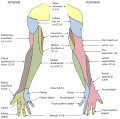 Gray's Anatomy illustration of cutaneous innervation of the upper limbs

Advertise on WikiMD — 81,000+ full articles, ~900,000 total pages, ~250 million page views. Global reach, limited time promotional rates from $1/page/day. Learn more · View stats

Translate page: - East Asian
中文,
日本,
한국어,
South Asian
हिन्दी,
தமிழ்,
తెలుగు,
Urdu,
ಕನ್ನಡ,
Southeast Asian
Indonesian,
Vietnamese,
Thai,
မြန်မာဘာသာ,
বাংলা
European
español,
Deutsch,
français,
Greek,
português do Brasil,
polski,
română,
русский,
Nederlands,
norsk,
svenska,
suomi,
Italian
Middle Eastern & African
عربى,
Turkish,
Persian,
Hebrew,
Afrikaans,
isiZulu,
Kiswahili,
Other
Bulgarian,
Hungarian,
Czech,
Swedish,
മലയാളം,
मराठी,
ਪੰਜਾਬੀ,
ગુજરાતી,
Portuguese,
Ukrainian
About WikiMD • Contact • Disclaimer • Privacy • Copyright • Site statistics
Some content and images may originate from Wikimedia Commons or Wikipedia and remain subject to their stated licenses. Unless otherwise noted, eligible WikiMD content is available under CC BY-SA 4.0.
WikiMD Wellnesspedia — Free health & wellness information for patients, students, and health professionals.

