Curtin–Hammett principle
The Curtin–Hammett principle is a fundamental concept in the field of chemical kinetics and thermodynamics that explains the preference for the formation of one product over another in a chemical reaction, even when the reactants can proceed through two or more different transition states leading to different products. This principle is named after Donald J. Curtin and Louis P. Hammett, who independently formulated the concept in the 20th century. The principle has profound implications in the understanding of chemical equilibrium, reaction mechanisms, and the design of chemical reactions in both organic and inorganic chemistry.
Overview[edit]
The Curtin–Hammett principle states that in a chemical equilibrium, the product distribution is determined not by the stability of the products themselves but by the difference in free energy of the transition states leading to those products. This means that the product ratio is dependent on the difference in activation energy between the competing reaction pathways, rather than the difference in energy between the final products.
Application[edit]
The principle is widely applied in organic synthesis to explain and predict the outcome of chemical reactions, especially when dealing with reactions that have competing pathways. It is particularly useful in understanding stereoselective and regioselective reactions, where the formation of one isomer or regioisomer is favored over another. The Curtin–Hammett principle helps chemists design reactions and select conditions that favor the formation of the desired product.
Key Concepts[edit]
- Transition State: The high-energy state through which reactants must pass to be converted into products. The energy required to reach the transition state from the reactants is the activation energy.
- Free Energy: A thermodynamic quantity that is a measure of the energy available to do work. The difference in free energy between the transition states determines the product distribution according to the Curtin–Hammett principle.
- Chemical Equilibrium: A state in a reversible chemical reaction where the rates of the forward and reverse reactions are equal, leading to constant concentrations of reactants and products.
Mathematical Description[edit]
The principle can be quantitatively described using the equation derived from the Gibbs free energy:
\[\Delta G^\ddagger = -RT \ln \left( \frac{k_1}{k_2} \right)\]
where \(\Delta G^\ddagger\) is the difference in Gibbs free energy between the two transition states, \(R\) is the gas constant, \(T\) is the temperature in Kelvin, and \(k_1\) and \(k_2\) are the rate constants for the competing reactions. This equation shows that the product ratio is determined by the difference in free energy of the transition states.
Limitations[edit]
While the Curtin–Hammett principle is widely applicable, it has limitations. It assumes that the interconversion between different reactant states is fast compared to the formation of the product, and that the reaction proceeds through well-defined transition states. In systems where these conditions are not met, the principle may not accurately predict the outcome of the reaction.
Conclusion[edit]
The Curtin–Hammett principle is a cornerstone of theoretical and applied chemistry, providing a framework for understanding and predicting the outcomes of chemical reactions based on the properties of transition states. Its application spans across various fields of chemistry, offering insights into reaction mechanisms and guiding the development of new synthetic methodologies.

Curtin–Hammett principle gallery[edit]
-
 Curtin-Hammett Principle Diagram
 -
 Piperidine Oxidation
 -
 Tropane Alkylation
 -
 Cyclohexyl Iodide Eliel
 -
 Methylation
 -
 Product Selectivity
 -
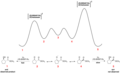 Energy Diagram for the Noyori Asymmetric Hydrogenation
 -
 Enantioselective Lithiation
 -
 Monoacylation
 -
 Acylation Selectivity


Medical Disclaimer: WikiMD is for informational purposes only and is not a substitute for professional medical advice. Content may be inaccurate or outdated and should not be used for diagnosis or treatment. Always consult your healthcare provider for medical decisions. Verify information with trusted sources such as CDC.gov and NIH.gov. By using this site, you agree that WikiMD is not liable for any outcomes related to its content. See full disclaimer.
Credits:Most images are courtesy of Wikimedia commons, and templates, categories Wikipedia, licensed under CC BY SA or similar.
Translate page: - East Asian
中文,
日本,
한국어,
South Asian
हिन्दी,
தமிழ்,
తెలుగు,
Urdu,
ಕನ್ನಡ,
Southeast Asian
Indonesian,
Vietnamese,
Thai,
မြန်မာဘာသာ,
বাংলা
European
español,
Deutsch,
français,
Greek,
português do Brasil,
polski,
română,
русский,
Nederlands,
norsk,
svenska,
suomi,
Italian
Middle Eastern & African
عربى,
Turkish,
Persian,
Hebrew,
Afrikaans,
isiZulu,
Kiswahili,
Other
Bulgarian,
Hungarian,
Czech,
Swedish,
മലയാളം,
मराठी,
ਪੰਜਾਬੀ,
ગુજરાતી,
Portuguese,
Ukrainian

