Curcuma
Curcuma is a genus of about 100 accepted species in the family Zingiberaceae that contains such species as turmeric and Siam Tulip. They are native to Southeast Asia, southern China, the Indian Subcontinent, New Guinea and northern Australia. Some species are reportedly naturalized in other warm parts of the world such as tropical Africa, Central America, Florida, and various islands of the Pacific, Indian and Atlantic Oceans.
Description[edit]
Species in the genus Curcuma are rhizomatous herbs. The inflorescences take the form of a spike or raceme, and are often subtended by a showy pair of petal-like bracts. The bracteole is tubular, often as long as the floral leaves. The calyx is short and tubular, cut obliquely at the top. The corolla is tubular at the base, with the lateral lobes of the limb very short and the central lobe large and concave. There are two lateral staminodes. The labellum is large and usually forms two lateral lobes or wings, and the anther has a long base and is spurred, with the spur often as long as the anther's back.
Species[edit]
Some of the species within the genus Curcuma include:
- Curcuma longa - Turmeric
- Curcuma zedoaria - White Turmeric
- Curcuma angustifolia - East Indian Arrowroot
- Curcuma aromatica - Wild Turmeric
- Curcuma caesia - Black Turmeric
- Curcuma amada - Mango Ginger
Uses[edit]
Curcuma species are used as food plants by the larvae of some Lepidoptera species including the moth Endoclita malabaricus. Some species naturally produce a compound called curcumin, which is used in both food and medicine.
See also[edit]
References[edit]
External links[edit]
- Sorting Curcuma names - Multilingual Multiscript Plant Name Database

This WikiMD article can only be edited by registered and verified editors. You can log in or register.
-
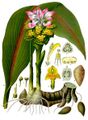 Curcuma zedoaria
 -
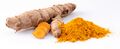 Curcuma longa roots
 -
Curcuma zerumbet
-
Curcuma inodora
-
Curcuma domestica
-
Curcuma longa
-
Curcuma aeruginosa
-
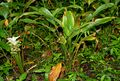 Curcuma longa (Haldi)
 -
Curcuma by titanium22
-
Curcuma sp.


_Im_IMG_2441.jpg)

Medical Disclaimer: WikiMD is for informational purposes only and is not a substitute for professional medical advice. Content may be inaccurate or outdated and should not be used for diagnosis or treatment. Always consult your healthcare provider for medical decisions. Verify information with trusted sources such as CDC.gov and NIH.gov. By using this site, you agree that WikiMD is not liable for any outcomes related to its content. See full disclaimer.
Credits:Most images are courtesy of Wikimedia commons, and templates, categories Wikipedia, licensed under CC BY SA or similar.
Translate page: - East Asian
中文,
日本,
한국어,
South Asian
हिन्दी,
தமிழ்,
తెలుగు,
Urdu,
ಕನ್ನಡ,
Southeast Asian
Indonesian,
Vietnamese,
Thai,
မြန်မာဘာသာ,
বাংলা
European
español,
Deutsch,
français,
Greek,
português do Brasil,
polski,
română,
русский,
Nederlands,
norsk,
svenska,
suomi,
Italian
Middle Eastern & African
عربى,
Turkish,
Persian,
Hebrew,
Afrikaans,
isiZulu,
Kiswahili,
Other
Bulgarian,
Hungarian,
Czech,
Swedish,
മലയാളം,
मराठी,
ਪੰਜਾਬੀ,
ગુજરાતી,
Portuguese,
Ukrainian


