Cryostat
A Cryostat is a device used to maintain low cryogenic temperatures of samples or devices mounted within the cryostat. Low temperatures may be maintained within a cryostat by using various refrigeration methods, most commonly using cryogenic fluid bath such as liquid helium. Hence it can be used to maintain a low temperature around a sample or device, typically for scientific or technological applications.
Function[edit]
Cryostats have a wide range of applications in scientific research that require low-temperature environments. These include studies in physics, chemistry, and materials science. The cryostat helps to reduce thermal noise when making precision measurements.
Types of Cryostats[edit]
There are several types of cryostats used in various fields. These include:
- Continuous-flow cryostats: These are the most common type of cryostat. They use a constant flow of cryogenic liquid to cool the sample.
- Bath cryostats: These cryostats immerse the sample in a bath of cryogenic liquid.
- Closed-cycle cryostats: These cryostats use a closed cycle of gas that is cooled to cryogenic temperatures.
- Multistage cryostats: These cryostats use multiple cooling stages to reach very low temperatures.
See Also[edit]
References[edit]
External Links[edit]
- WikiMD Article on Cryostat

This WikiMD article can only be edited by registered and verified editors. You can log in or register.
Cryostat[edit]
-
 Freezing WISE's Hydrogen
 -
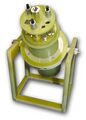 Cryostat Non Metallic Tiltable
 -
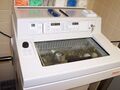 Cryostat Microtome


Medical Disclaimer: WikiMD is for informational purposes only and is not a substitute for professional medical advice. Content may be inaccurate or outdated and should not be used for diagnosis or treatment. Always consult your healthcare provider for medical decisions. Verify information with trusted sources such as CDC.gov and NIH.gov. By using this site, you agree that WikiMD is not liable for any outcomes related to its content. See full disclaimer.
Credits:Most images are courtesy of Wikimedia commons, and templates, categories Wikipedia, licensed under CC BY SA or similar.
Translate page: - East Asian
中文,
日本,
한국어,
South Asian
हिन्दी,
தமிழ்,
తెలుగు,
Urdu,
ಕನ್ನಡ,
Southeast Asian
Indonesian,
Vietnamese,
Thai,
မြန်မာဘာသာ,
বাংলা
European
español,
Deutsch,
français,
Greek,
português do Brasil,
polski,
română,
русский,
Nederlands,
norsk,
svenska,
suomi,
Italian
Middle Eastern & African
عربى,
Turkish,
Persian,
Hebrew,
Afrikaans,
isiZulu,
Kiswahili,
Other
Bulgarian,
Hungarian,
Czech,
Swedish,
മലയാളം,
मराठी,
ਪੰਜਾਬੀ,
ગુજરાતી,
Portuguese,
Ukrainian

