Crossed renal ectopia
Crossed renal ectopia is a rare congenital condition where both kidneys are located on the same side of the body. This anomaly occurs during fetal development, typically involving the migration of one kidney to the opposite side, crossing over the midline, and joining the other kidney. It can occur with or without fusion of the two kidneys. When fusion occurs, it is referred to as crossed fused renal ectopia. This condition is part of a broader category of renal ectopias, which are characterized by abnormal location or orientation of the kidneys.
Classification[edit]
Crossed renal ectopia is classified into several types based on the presence or absence of fusion and the final position of the ectopic kidney:
- Crossed renal ectopia without fusion: The ectopic kidney crosses the midline without fusing to the other kidney.
- Crossed fused renal ectopia: The most common type, where the ectopic kidney crosses the midline and fuses to the other kidney. This category can be further divided based on the position and orientation of the fused kidneys.
Causes[edit]
The exact cause of crossed renal ectopia is unknown. However, it is believed to result from errors in the migration of the kidneys during fetal development. Genetic factors and environmental influences may play a role, but specific risk factors have yet to be clearly identified.
Symptoms[edit]
Many individuals with crossed renal ectopia are asymptomatic and the condition is often discovered incidentally during imaging studies for unrelated reasons. When symptoms do occur, they may include:
- Urinary tract infections
- Abdominal or flank pain
- Palpable abdominal mass
- Hematuria (blood in urine)
Diagnosis[edit]
Crossed renal ectopia is typically diagnosed through imaging studies, including:
- Ultrasonography: Often the first imaging modality used, especially in children.
- CT scan: Provides detailed images and can confirm the diagnosis and the specific type of crossed renal ectopia.
- Magnetic resonance imaging (MRI): Useful for detailed anatomical assessment, especially in complex cases.
Treatment[edit]
Treatment of crossed renal ectopia depends on the presence of symptoms or complications. In asymptomatic cases, no treatment may be necessary, and the condition can be managed with regular monitoring. For symptomatic individuals, treatment options may include:
- Management of urinary tract infections with antibiotics
- Surgical intervention in cases of significant obstruction, recurrent infections, or other complications
Prognosis[edit]
The prognosis for individuals with crossed renal ectopia is generally good, especially for those without fusion or associated urological anomalies. The presence of fusion and additional anomalies may require more careful management and can be associated with a higher risk of complications.
Epidemiology[edit]
Crossed renal ectopia is a rare condition, with an estimated incidence of 1 in 7,000 to 1 in 1,000 live births. It occurs more frequently in males than in females and is often associated with other congenital anomalies.
 | This medical article is a stub. You can help WikiMD by expanding the page. |
-
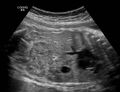 Crossed renal ectopia


Medical Disclaimer: WikiMD is for informational purposes only and is not a substitute for professional medical advice. Content may be inaccurate or outdated and should not be used for diagnosis or treatment. Always consult your healthcare provider for medical decisions. Verify information with trusted sources such as CDC.gov and NIH.gov. By using this site, you agree that WikiMD is not liable for any outcomes related to its content. See full disclaimer.
Credits:Most images are courtesy of Wikimedia commons, and templates, categories Wikipedia, licensed under CC BY SA or similar.
Translate page: - East Asian
中文,
日本,
한국어,
South Asian
हिन्दी,
தமிழ்,
తెలుగు,
Urdu,
ಕನ್ನಡ,
Southeast Asian
Indonesian,
Vietnamese,
Thai,
မြန်မာဘာသာ,
বাংলা
European
español,
Deutsch,
français,
Greek,
português do Brasil,
polski,
română,
русский,
Nederlands,
norsk,
svenska,
suomi,
Italian
Middle Eastern & African
عربى,
Turkish,
Persian,
Hebrew,
Afrikaans,
isiZulu,
Kiswahili,
Other
Bulgarian,
Hungarian,
Czech,
Swedish,
മലയാളം,
मराठी,
ਪੰਜਾਬੀ,
ગુજરાતી,
Portuguese,
Ukrainian

