Press release
Press Release
A press release, also known as a news release, media release, or press statement, is a written or recorded communication directed at members of the news media for the purpose of announcing something ostensibly newsworthy. Typically, they are mailed, faxed, or e-mailed to assignment editors and journalists at newspapers, magazines, radio stations, online media, television stations or television networks.
History[edit]
The first press release was created by Ivy Lee. Lee's agency was working with the Pennsylvania Railroad at the time of the 1906 Atlantic City train wreck. Ivy Lee and the Pennsylvania Railroad received widespread acclaim for their handling of the crisis, and this helped to further establish Ivy Lee as a major player in the public relations world.
Content[edit]
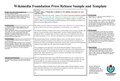
A press release body consists of four parts:
- Title or headline: The headline or title summarizes the content of the press release in a catchy way to attract the attention of journalists.
- Dateline: The dateline contains the release date and usually the originating city of the press release.
- Introduction: The introduction is where the real news content is. The first paragraph (two to three sentences) should sum up the press release, and the additional content must elaborate it.
- Body: The body of press release is where the real story is. This is where you provide details, background, and supporting information.
Distribution models[edit]
In the traditional distribution model, the business, political campaign, or other entity releasing information to the media hires a publicity agency to write and distribute written information to the newswires. The newswire then disseminates the information as it is received or as investigated by a journalist.
See also[edit]
References[edit]
<references />
External links[edit]
- The death of the press release - PR Daily




Ad. Transform your life with W8MD's
GLP-1 weight loss injections special from $29.99 with insurance
|
WikiMD Medical Encyclopedia |
Medical Disclaimer: WikiMD is for informational purposes only and is not a substitute for professional medical advice. Content may be inaccurate or outdated and should not be used for diagnosis or treatment. Always consult your healthcare provider for medical decisions. Verify information with trusted sources such as CDC.gov and NIH.gov. By using this site, you agree that WikiMD is not liable for any outcomes related to its content. See full disclaimer.
Credits:Most images are courtesy of Wikimedia commons, and templates, categories Wikipedia, licensed under CC BY SA or similar.
Translate this page: - East Asian
中文,
日本,
한국어,
South Asian
हिन्दी,
தமிழ்,
తెలుగు,
Urdu,
ಕನ್ನಡ,
Southeast Asian
Indonesian,
Vietnamese,
Thai,
မြန်မာဘာသာ,
বাংলা
European
español,
Deutsch,
français,
Greek,
português do Brasil,
polski,
română,
русский,
Nederlands,
norsk,
svenska,
suomi,
Italian
Middle Eastern & African
عربى,
Turkish,
Persian,
Hebrew,
Afrikaans,
isiZulu,
Kiswahili,
Other
Bulgarian,
Hungarian,
Czech,
Swedish,
മലയാളം,
मराठी,
ਪੰਜਾਬੀ,
ગુજરાતી,
Portuguese,
Ukrainian
