Common gamma chain
The common gamma chain (_c), also known as CD132, is a critical component of several cytokine receptors in the immune system. It is shared by the receptors for interleukins IL-2, IL-4, IL-7, IL-9, IL-15, and IL-21. The common gamma chain is essential for the signaling pathways that regulate the development, proliferation, and function of various immune cells.
Structure[edit]
The common gamma chain is a type I transmembrane protein that consists of an extracellular domain, a transmembrane domain, and a cytoplasmic domain. The extracellular domain is responsible for binding to the cytokine receptor complexes, while the cytoplasmic domain is involved in signal transduction.
Function[edit]
The common gamma chain is crucial for the function of several cytokine receptors:
- IL-2 Receptor: The common gamma chain is part of the high-affinity IL-2 receptor complex, which is important for T cell proliferation and survival.
- IL-4 Receptor: It is involved in the IL-4 receptor complex, which plays a role in B cell differentiation and IgE production.
- IL-7 Receptor: The common gamma chain is essential for the IL-7 receptor, which is critical for T cell development in the thymus.
- IL-9 Receptor: It participates in the IL-9 receptor complex, influencing the growth of T cells and mast cells.
- IL-15 Receptor: The common gamma chain is part of the IL-15 receptor, which is important for the development and function of natural killer cells.
- IL-21 Receptor: It is involved in the IL-21 receptor complex, which affects the function of T cells, B cells, and natural killer cells.
Signaling Pathways[edit]
The common gamma chain is involved in the activation of several signaling pathways, including the JAK-STAT pathway. Upon cytokine binding, the associated Janus kinases (JAKs) are activated, leading to the phosphorylation of STAT proteins, which then translocate to the nucleus to modulate gene expression.
Clinical Significance[edit]
Mutations in the gene encoding the common gamma chain, IL2RG, can lead to X-linked severe combined immunodeficiency (X-SCID), a condition characterized by a severely compromised immune system. Patients with X-SCID are highly susceptible to infections and require early intervention, such as bone marrow transplantation.
Related Pages[edit]
| Immunology | ||||||||||
|---|---|---|---|---|---|---|---|---|---|---|
This immunology-related article is a stub.
|
-
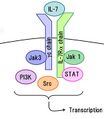 Common gamma chain

Advertise on WikiMD — 81,000+ full articles, ~900,000 total pages, ~250 million page views. Global reach, limited time promotional rates from $1/page/day. Learn more · View stats

Medical Disclaimer: WikiMD is for informational purposes only and is not a substitute for professional medical advice. Content may be inaccurate or outdated and should not be used for diagnosis or treatment. Always consult your healthcare provider for medical decisions. Verify information with trusted sources such as CDC.gov and NIH.gov. By using this site, you agree that WikiMD is not liable for any outcomes related to its content. See full disclaimer.
Credits:Most images are courtesy of Wikimedia commons, and templates, categories Wikipedia, licensed under CC BY SA or similar.
Translate page: - East Asian
中文,
日本,
한국어,
South Asian
हिन्दी,
தமிழ்,
తెలుగు,
Urdu,
ಕನ್ನಡ,
Southeast Asian
Indonesian,
Vietnamese,
Thai,
မြန်မာဘာသာ,
বাংলা
European
español,
Deutsch,
français,
Greek,
português do Brasil,
polski,
română,
русский,
Nederlands,
norsk,
svenska,
suomi,
Italian
Middle Eastern & African
عربى,
Turkish,
Persian,
Hebrew,
Afrikaans,
isiZulu,
Kiswahili,
Other
Bulgarian,
Hungarian,
Czech,
Swedish,
മലയാളം,
मराठी,
ਪੰਜਾਬੀ,
ગુજરાતી,
Portuguese,
Ukrainian

