Circular chromosome
Circular chromosome is a type of chromosome that, unlike the linear chromosomes found in eukaryotic cells, forms a closed loop. This structure is commonly found in prokaryotes, such as bacteria and archaea, as well as in mitochondria and chloroplasts, the energy-producing organelles in eukaryotic cells.
Structure and Function[edit]
A circular chromosome is a continuous, circular DNA molecule that often contains the entire genetic material of a cell. This contrasts with eukaryotic chromosomes, which are linear and located within the cell nucleus. In prokaryotes, the circular chromosome is located in the nucleoid, a region of the cell that lacks a surrounding membrane.
The circular structure of prokaryotic chromosomes has implications for DNA replication. Unlike in eukaryotes, where replication begins at multiple points along the chromosome, replication in prokaryotes typically begins at a single point, the origin of replication. The replication process proceeds in both directions around the circle until the two replication forks meet on the opposite side of the chromosome.
Variations[edit]
While most prokaryotes have a single circular chromosome, some species have multiple circular chromosomes. Additionally, many prokaryotes have smaller circular DNA molecules called plasmids. Plasmids often carry genes that confer advantageous traits, such as antibiotic resistance.
In eukaryotes, circular chromosomes are found in the mitochondria and chloroplasts. These organelles are thought to have originated from free-living prokaryotes that were engulfed by a precursor to the modern eukaryotic cell, a process known as endosymbiosis. As a result, they have retained their own genomes, which are circular.
See Also[edit]
References[edit]

-
 Diagram of circular DNA replication
 -
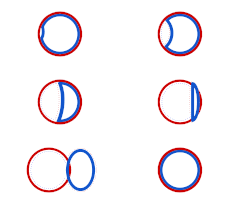 Animation of circular bacterial chromosome replication


Medical Disclaimer: WikiMD is for informational purposes only and is not a substitute for professional medical advice. Content may be inaccurate or outdated and should not be used for diagnosis or treatment. Always consult your healthcare provider for medical decisions. Verify information with trusted sources such as CDC.gov and NIH.gov. By using this site, you agree that WikiMD is not liable for any outcomes related to its content. See full disclaimer.
Credits:Most images are courtesy of Wikimedia commons, and templates, categories Wikipedia, licensed under CC BY SA or similar.
Translate page: - East Asian
中文,
日本,
한국어,
South Asian
हिन्दी,
தமிழ்,
తెలుగు,
Urdu,
ಕನ್ನಡ,
Southeast Asian
Indonesian,
Vietnamese,
Thai,
မြန်မာဘာသာ,
বাংলা
European
español,
Deutsch,
français,
Greek,
português do Brasil,
polski,
română,
русский,
Nederlands,
norsk,
svenska,
suomi,
Italian
Middle Eastern & African
عربى,
Turkish,
Persian,
Hebrew,
Afrikaans,
isiZulu,
Kiswahili,
Other
Bulgarian,
Hungarian,
Czech,
Swedish,
മലയാളം,
मराठी,
ਪੰਜਾਬੀ,
ગુજરાતી,
Portuguese,
Ukrainian

