Camptocormia
Camptocormia is a medical condition characterized by severe abnormal posturing of the trunk, which is bent forward and can only be minimally corrected voluntarily. The term "camptocormia" originates from the Greek words "kamptein" (to bend) and "kormos" (trunk). This condition is also known as "bent spine syndrome".
Etiology[edit]
Camptocormia is often associated with neurological disorders, particularly Parkinson's disease, dystonia, and myopathy. It can also occur as a result of muscular dystrophy or myositis. In some cases, the cause of camptocormia is unknown, and it is then referred to as "idiopathic camptocormia".
Symptoms[edit]
The primary symptom of camptocormia is a forward bending of the spine, which increases during standing or walking and decreases in a supine position. Other symptoms may include back pain, fatigue, and muscle weakness.
Diagnosis[edit]
The diagnosis of camptocormia is primarily based on clinical examination. Imaging studies, such as MRI, may be used to rule out other causes of the abnormal posture. Electromyography can be used to evaluate muscle activity and detect any abnormalities.
Treatment[edit]
Treatment of camptocormia is largely symptomatic and may include physical therapy, occupational therapy, and the use of assistive devices. In some cases, medication or surgery may be necessary.
See also[edit]
 | This medical article is a stub. You can help WikiMD by expanding the page. |
Camptocormia[edit]
-
 Camptocormia
 -
 Alexandre Achille Souques
 -
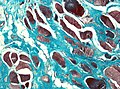 Deposit of fibrosis and fatty infiltration
 -
 Thymatron IV
 -
 Typical deep brain stimulation setup


Medical Disclaimer: WikiMD is for informational purposes only and is not a substitute for professional medical advice. Content may be inaccurate or outdated and should not be used for diagnosis or treatment. Always consult your healthcare provider for medical decisions. Verify information with trusted sources such as CDC.gov and NIH.gov. By using this site, you agree that WikiMD is not liable for any outcomes related to its content. See full disclaimer.
Credits:Most images are courtesy of Wikimedia commons, and templates, categories Wikipedia, licensed under CC BY SA or similar.
Translate page: - East Asian
中文,
日本,
한국어,
South Asian
हिन्दी,
தமிழ்,
తెలుగు,
Urdu,
ಕನ್ನಡ,
Southeast Asian
Indonesian,
Vietnamese,
Thai,
မြန်မာဘာသာ,
বাংলা
European
español,
Deutsch,
français,
Greek,
português do Brasil,
polski,
română,
русский,
Nederlands,
norsk,
svenska,
suomi,
Italian
Middle Eastern & African
عربى,
Turkish,
Persian,
Hebrew,
Afrikaans,
isiZulu,
Kiswahili,
Other
Bulgarian,
Hungarian,
Czech,
Swedish,
മലയാളം,
मराठी,
ਪੰਜਾਬੀ,
ગુજરાતી,
Portuguese,
Ukrainian

