Cadmium sulfide

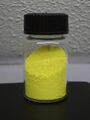
Cadmium sulfide (CdS) is a chemical compound that is a yellow solid. It is an important material in the field of semiconductors and is used in a variety of applications, including solar cells, photodetectors, and as a pigment in paints.
Chemical Properties[edit]
Cadmium sulfide is composed of cadmium and sulfur, with the chemical formula CdS. It is a binary compound and is known for its bright yellow color. CdS is insoluble in water but can be dissolved in acids. It has a melting point of 1750 °C and a density of 4.826 g/cm_.
Crystal Structure[edit]
CdS can exist in two different crystal structures: the wurtzite structure and the zinc blende structure. The wurtzite structure is hexagonal, while the zinc blende structure is cubic. The wurtzite form is more stable at room temperature.
Applications[edit]
Pigments[edit]
Cadmium sulfide is used as a pigment known as "cadmium yellow." It is valued for its bright color and stability. It is used in artists' paints, plastics, and ceramics.
Semiconductors[edit]
CdS is a direct bandgap semiconductor with a bandgap of about 2.42 eV at room temperature. This makes it suitable for use in photovoltaic cells and photodetectors. It is often used in thin-film solar cells, where it acts as a window layer that allows light to pass through to the active layer.
Photoconductors[edit]
Cadmium sulfide is also used in photoconductors, which are materials that become more conductive when exposed to light. This property is utilized in light sensors and photocopying machines.
Safety and Environmental Concerns[edit]
Cadmium compounds, including cadmium sulfide, are toxic and pose environmental and health risks. Exposure to cadmium can cause serious health problems, including kidney damage and bone disease. Therefore, the use of cadmium sulfide is regulated in many countries, and alternatives are often sought in applications where possible.
Related Pages[edit]
-
 Cadmium sulfide


Medical Disclaimer: WikiMD is for informational purposes only and is not a substitute for professional medical advice. Content may be inaccurate or outdated and should not be used for diagnosis or treatment. Always consult your healthcare provider for medical decisions. Verify information with trusted sources such as CDC.gov and NIH.gov. By using this site, you agree that WikiMD is not liable for any outcomes related to its content. See full disclaimer.
Credits:Most images are courtesy of Wikimedia commons, and templates, categories Wikipedia, licensed under CC BY SA or similar.
Translate page: - East Asian
中文,
日本,
한국어,
South Asian
हिन्दी,
தமிழ்,
తెలుగు,
Urdu,
ಕನ್ನಡ,
Southeast Asian
Indonesian,
Vietnamese,
Thai,
မြန်မာဘာသာ,
বাংলা
European
español,
Deutsch,
français,
Greek,
português do Brasil,
polski,
română,
русский,
Nederlands,
norsk,
svenska,
suomi,
Italian
Middle Eastern & African
عربى,
Turkish,
Persian,
Hebrew,
Afrikaans,
isiZulu,
Kiswahili,
Other
Bulgarian,
Hungarian,
Czech,
Swedish,
മലയാളം,
मराठी,
ਪੰਜਾਬੀ,
ગુજરાતી,
Portuguese,
Ukrainian

