Bromopyruvic acid
Bromopyruvic acid (also known as 3-bromopyruvic acid or 3-BrPA) is a halogenated derivative of pyruvic acid. It is a small, simple molecule that has been studied for its potential use in cancer treatment.
Etymology[edit]
The term "bromopyruvic acid" is derived from its chemical structure. The prefix "bromo-" refers to the presence of a bromine atom, while "pyruvic acid" refers to the pyruvate molecule, which is a key intermediate in several metabolic pathways.
Chemical Structure and Properties[edit]
Bromopyruvic acid is a halogenated derivative of pyruvic acid. It has a molecular formula of C3H3BrO3 and a molecular weight of 166.96 g/mol. The bromine atom in bromopyruvic acid is responsible for its potential as an alkylating agent.
Potential Use in Cancer Treatment[edit]
Bromopyruvic acid has been studied for its potential use in cancer treatment. It is thought to work by inhibiting the glycolysis pathway, which is often upregulated in cancer cells. This could potentially starve the cancer cells of energy, leading to their death.
Related Terms[edit]
- Pyruvic acid: The molecule from which bromopyruvic acid is derived.
- Glycolysis: The metabolic pathway that bromopyruvic acid is thought to inhibit.
- Alkylating agent: A type of drug that bromopyruvic acid could potentially act as.
See Also[edit]
References[edit]

This WikiMD article can only be edited by registered and verified editors. You can log in or register.
-
Bromopyruvic acid structural formula
-
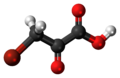 Bromopyruvic acid 3D ball model


Medical Disclaimer: WikiMD is for informational purposes only and is not a substitute for professional medical advice. Content may be inaccurate or outdated and should not be used for diagnosis or treatment. Always consult your healthcare provider for medical decisions. Verify information with trusted sources such as CDC.gov and NIH.gov. By using this site, you agree that WikiMD is not liable for any outcomes related to its content. See full disclaimer.
Credits:Most images are courtesy of Wikimedia commons, and templates, categories Wikipedia, licensed under CC BY SA or similar.
Translate page: - East Asian
中文,
日本,
한국어,
South Asian
हिन्दी,
தமிழ்,
తెలుగు,
Urdu,
ಕನ್ನಡ,
Southeast Asian
Indonesian,
Vietnamese,
Thai,
မြန်မာဘာသာ,
বাংলা
European
español,
Deutsch,
français,
Greek,
português do Brasil,
polski,
română,
русский,
Nederlands,
norsk,
svenska,
suomi,
Italian
Middle Eastern & African
عربى,
Turkish,
Persian,
Hebrew,
Afrikaans,
isiZulu,
Kiswahili,
Other
Bulgarian,
Hungarian,
Czech,
Swedish,
മലയാളം,
मराठी,
ਪੰਜਾਬੀ,
ગુજરાતી,
Portuguese,
Ukrainian


