Bloodmobile

- Bloodmobiles have revolutionized the approach to blood donation, bringing convenience and efficiency to a life-saving medical practice. These mobile units are integral in broadening the outreach of blood donation campaigns, ensuring that even those who might not visit a stationary donation center can contribute to the invaluable blood bank reserves.
Overview[edit]
A bloodmobile is, in essence, a traveling blood donation center. Typically fashioned from large vehicles such as buses or vans, they are meticulously equipped with all the essential tools, equipment, and facilities required for a safe and efficient blood donation procedure[1].
Locations and Venues[edit]
Bloodmobiles strategically operate in various public locales, such as:
Colleges and universities Churches Shopping centers Community events or fairs Moreover, various organizations recognize the societal and health benefits of blood donation. As such:
Large corporations and businesses often sponsor mobile blood drives. In a bid to encourage participation, employees might be granted a short leave from their duties to donate. High schools have taken to organizing annual blood donation campaigns, enabling students aged 16 and above to partake, given they have the necessary permissions[2].
Incentives and Encouragements[edit]
To bolster participation, incentives are often provided to donors. These might range from refreshments and snacks to keep energy levels stable post-donation, commemorative T-shirts to promote the act, or in the case of students, a short respite from classes[3]. More than tangible rewards, the act often becomes a communal experience, fostering positive peer pressure and promoting the ethical and health benefits of donating blood.
Significance and Impact[edit]
Bloodmobiles have played a pivotal role in augmenting the blood supplies of hospitals and clinics. By reaching out directly to communities, they help bridge the gap between the demand for and supply of blood, particularly during emergencies or crises[4]. Furthermore, their accessibility often educates the general public about the significance of regular blood donation.
Conclusion[edit]
The concept of the bloodmobile has transformed the dynamics of blood donation, ensuring that the vital act of giving blood becomes as convenient as possible. As medical demands grow and communities expand, the role of the bloodmobile remains indispensable in contemporary healthcare.
Gallery[edit]
-
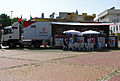 A Bloodmobile of Turkish Red Crescent in Gazipaşa

See also[edit]
External links[edit]
References[edit]
- ↑ Jones, J. M., Sapiano, M. R. P., Savinkina, A. A., Haass, K. A., Baker, M. L., Henry, R. A., & Berger, J. J. (2019). Slowing decline in blood collection and transfusion in the United States - 2017. Transfusion, 59(S2), 675-684.
- ↑ France, C. R., France, J. L., Roussos, M., & Ditto, B. (2004). Mild reactions to blood donation predict a decreased likelihood of donor return. Transfusion, 44(2), 277-280.
- ↑ Newman, B. H. (2004). Blood donation-related neurologic needle injury: evaluation of 2 years' worth of data from a large blood center. Transfusion, 44(7), 1076-1079.
- ↑ Steele, W. R., High, P. M., Schreiber, G. B., Liu, J., & Sayers, M. H. (2018). Safety, efficacy, and future directions in bloodmobiles: a descriptive study. Transfusion Medicine Reviews, 32(3), 178-183.
 | This medical article is a stub. You can help WikiMD by expanding the page. |

Medical Disclaimer: WikiMD is for informational purposes only and is not a substitute for professional medical advice. Content may be inaccurate or outdated and should not be used for diagnosis or treatment. Always consult your healthcare provider for medical decisions. Verify information with trusted sources such as CDC.gov and NIH.gov. By using this site, you agree that WikiMD is not liable for any outcomes related to its content. See full disclaimer.
Credits:Most images are courtesy of Wikimedia commons, and templates, categories Wikipedia, licensed under CC BY SA or similar.
Translate page: - East Asian
中文,
日本,
한국어,
South Asian
हिन्दी,
தமிழ்,
తెలుగు,
Urdu,
ಕನ್ನಡ,
Southeast Asian
Indonesian,
Vietnamese,
Thai,
မြန်မာဘာသာ,
বাংলা
European
español,
Deutsch,
français,
Greek,
português do Brasil,
polski,
română,
русский,
Nederlands,
norsk,
svenska,
suomi,
Italian
Middle Eastern & African
عربى,
Turkish,
Persian,
Hebrew,
Afrikaans,
isiZulu,
Kiswahili,
Other
Bulgarian,
Hungarian,
Czech,
Swedish,
മലയാളം,
मराठी,
ਪੰਜਾਬੀ,
ગુજરાતી,
Portuguese,
Ukrainian

