Birt–Hogg–Dubé syndrome

Prab R. Tumpati, MD — Editor-in-Chief, WikiMD Medical Encyclopedia
Internal medicine • Obesity medicine • Sleep medicine
Professional affiliations: Founder of WikiMD and W8MD Weight Loss, Sleep & MedSpa.
Biography, credentials and affiliations • Editorial policy • Disclosure policy
| Birt–Hogg–Dubé syndrome | |
|---|---|

| |
| Synonyms | BHD, Hornstein–Knickenberg syndrome |
| Pronounce | |
| Specialty | Dermatology, Genetics |
| Symptoms | Fibrofolliculomas, trichodiscomas, acrochordons, pulmonary cysts, spontaneous pneumothorax, renal tumors |
| Complications | Renal cell carcinoma |
| Onset | Typically in adulthood |
| Duration | Chronic |
| Types | |
| Causes | Mutations in the FLCN gene |
| Risks | Family history of the condition |
| Diagnosis | Genetic testing, clinical examination |
| Differential diagnosis | Tuberous sclerosis, neurofibromatosis |
| Prevention | |
| Treatment | Surveillance, surgical removal of tumors |
| Medication | |
| Prognosis | Generally good with management |
| Frequency | Rare |
| Deaths | |
Birt–Hogg–Dubé syndrome (BHD) is a rare genetic disorder that is associated with skin lesions, lung disease, and kidney tumors. It is named after the three scientists who first described the condition in 1977: Arthur R. Birt, Georgina R. Hogg, and Dr. William J. Dubé.
Symptoms and Signs[edit]
The symptoms of Birt–Hogg–Dubé syndrome can vary greatly from person to person. Some people may have only skin abnormalities, while others may also have lung and kidney problems. The skin lesions associated with BHD are often flesh-colored and can appear anywhere on the body, but they are most commonly found on the face, neck, and upper body. People with BHD are also at an increased risk of developing certain types of kidney cancer. These tumors usually develop in adulthood and can be either benign (noncancerous) or malignant (cancerous).
Causes[edit]
Birt–Hogg–Dubé syndrome is caused by mutations in the Folliculin (FLCN) gene. This gene provides instructions for making a protein that is involved in regulating cell growth and division. Mutations in the FLCN gene lead to the production of an abnormal folliculin protein, which disrupts the normal regulation of cell growth and division. This can lead to the formation of tumors and cysts in the skin, lungs, and kidneys.
Diagnosis[edit]
The diagnosis of Birt–Hogg–Dubé syndrome is based on a clinical evaluation, detailed patient history, and a variety of specialized tests. These tests may include a skin biopsy to examine the skin lesions, imaging tests such as a CT scan or MRI to look for lung and kidney abnormalities, and genetic testing to identify mutations in the FLCN gene.
Treatment[edit]
There is currently no cure for Birt–Hogg–Dubé syndrome. Treatment is aimed at managing the symptoms and preventing complications. This may include surgery to remove skin lesions or kidney tumors, medications to manage lung disease, and regular monitoring to detect any new tumors or cysts.
Gallery[edit]
-
 Birt–Hogg–Dubé syndrome
 -
 Birt–Hogg–Dubé syndrome
 -
Histopathology of chromophobe renal cell carcinoma
-
 Autosomal dominant inheritance pattern
 -
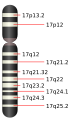 Chromosome 17
 -
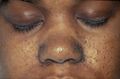 Patient with facial angiofibromas caused by tuberous sclerosis


See Also[edit]
References[edit]
- Birt AR, Hogg GR, Dubé WJ. Hereditary multiple fibrofolliculomas with trichodiscomas and acrochordons. Arch Dermatol. 1977 Dec;113(12):1674-7.
- Toro JR, Glenn G, Duray P, et al. Birt-Hogg-Dubé syndrome: a novel marker of kidney neoplasia. Arch Dermatol. 1999 Oct;135(10):1195-202.

Advertise on WikiMD — 81,000+ full articles, ~900,000 total pages, ~250 million page views. Global reach, limited time promotional rates from $1/page/day. Learn more · View stats


Translate page: - East Asian
中文,
日本,
한국어,
South Asian
हिन्दी,
தமிழ்,
తెలుగు,
Urdu,
ಕನ್ನಡ,
Southeast Asian
Indonesian,
Vietnamese,
Thai,
မြန်မာဘာသာ,
বাংলা
European
español,
Deutsch,
français,
Greek,
português do Brasil,
polski,
română,
русский,
Nederlands,
norsk,
svenska,
suomi,
Italian
Middle Eastern & African
عربى,
Turkish,
Persian,
Hebrew,
Afrikaans,
isiZulu,
Kiswahili,
Other
Bulgarian,
Hungarian,
Czech,
Swedish,
മലയാളം,
मराठी,
ਪੰਜਾਬੀ,
ગુજરાતી,
Portuguese,
Ukrainian
About WikiMD • Contact • Disclaimer • Privacy • Copyright • Site statistics
Some content and images may originate from Wikimedia Commons or Wikipedia and remain subject to their stated licenses. Unless otherwise noted, eligible WikiMD content is available under CC BY-SA 4.0.
WikiMD Wellnesspedia — Free health & wellness information for patients, students, and health professionals.


