Bicipital aponeurosis
Bicipital Aponeurosis (also known as Lacertus Fibrosus) is a significant anatomical structure in the human body, particularly in the upper limb region. It is a broad and thin fascial structure that originates from the biceps brachii, one of the major muscles of the upper arm.
Anatomy[edit]
The Bicipital Aponeurosis originates from the distal part of the biceps brachii muscle, specifically from the tendon of this muscle. It extends medially and downwards, crossing over the brachial artery and median nerve in the cubital fossa. It then blends with the deep fascia of the forearm.
Function[edit]
The primary function of the Bicipital Aponeurosis is to protect the underlying brachial artery and median nerve. By covering these structures, it provides a shield against potential injury. It also contributes to the flexion of the elbow joint, as it is connected to the biceps brachii, a major flexor of the elbow.
Clinical Significance[edit]
In medical practice, the Bicipital Aponeurosis is an important landmark for certain procedures such as the insertion of an intravenous (IV) line or the drawing of arterial blood gases from the brachial artery. Its location and the protection it provides to the underlying structures are crucial in preventing inadvertent injury during these procedures.
See Also[edit]
References[edit]

-
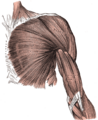 Gray's Anatomy illustration of the bicipital aponeurosis


Medical Disclaimer: WikiMD is for informational purposes only and is not a substitute for professional medical advice. Content may be inaccurate or outdated and should not be used for diagnosis or treatment. Always consult your healthcare provider for medical decisions. Verify information with trusted sources such as CDC.gov and NIH.gov. By using this site, you agree that WikiMD is not liable for any outcomes related to its content. See full disclaimer.
Credits:Most images are courtesy of Wikimedia commons, and templates, categories Wikipedia, licensed under CC BY SA or similar.
Translate page: - East Asian
中文,
日本,
한국어,
South Asian
हिन्दी,
தமிழ்,
తెలుగు,
Urdu,
ಕನ್ನಡ,
Southeast Asian
Indonesian,
Vietnamese,
Thai,
မြန်မာဘာသာ,
বাংলা
European
español,
Deutsch,
français,
Greek,
português do Brasil,
polski,
română,
русский,
Nederlands,
norsk,
svenska,
suomi,
Italian
Middle Eastern & African
عربى,
Turkish,
Persian,
Hebrew,
Afrikaans,
isiZulu,
Kiswahili,
Other
Bulgarian,
Hungarian,
Czech,
Swedish,
മലയാളം,
मराठी,
ਪੰਜਾਬੀ,
ગુજરાતી,
Portuguese,
Ukrainian

