Barley wine
Barley wine is a style of strong ale originating from England. This type of beer is called "wine" because its alcohol by volume (ABV) can be closer to that of wine than to other beers. However, it is made from grain rather than fruit, so it is, in fact, a beer. There are two primary styles of barley wine: the American, which tends to be more heavily hopped and thus more bitter, and the English, which is less bitter and may have a more pronounced malt flavor.
History[edit]
The term "barley wine" has been used in England since at least the 18th century, though the style is believed to have originated much earlier. The first barley wine to be marketed as such was Bass No. 1 Ale, released in 1870 by Bass Brewery. In the United States, Anchor Brewing Company was the first to produce a barley wine, called Old Foghorn, in the 1970s.
Characteristics[edit]
Barley wines range from 6% to 12% ABV and are typically brewed with a high percentage of malt, giving them a sweet, full-bodied flavor. They are often a deep copper color, though this can vary. The flavor profile can include notes of fruit, caramel, and toffee. Barley wines are often aged, which can result in additional flavors such as vanilla or oak.
Brewing[edit]
Brewing barley wine involves a long boil of the wort, which caramelizes the sugars and results in a rich, complex flavor. The beer is then fermented and aged. The aging process can last anywhere from a few months to several years.
Serving[edit]
Barley wine is typically served in small quantities, similar to wine, due to its high alcohol content. It is often served in a snifter or wine glass to enhance the aroma and flavor.
See also[edit]
 | This beer or brewery-related article is a stub. You can help WikiMD by expanding the page. |

-
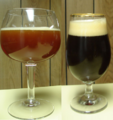 Barley wines
 -
Barley_wine


Medical Disclaimer: WikiMD is for informational purposes only and is not a substitute for professional medical advice. Content may be inaccurate or outdated and should not be used for diagnosis or treatment. Always consult your healthcare provider for medical decisions. Verify information with trusted sources such as CDC.gov and NIH.gov. By using this site, you agree that WikiMD is not liable for any outcomes related to its content. See full disclaimer.
Credits:Most images are courtesy of Wikimedia commons, and templates, categories Wikipedia, licensed under CC BY SA or similar.
Translate page: - East Asian
中文,
日本,
한국어,
South Asian
हिन्दी,
தமிழ்,
తెలుగు,
Urdu,
ಕನ್ನಡ,
Southeast Asian
Indonesian,
Vietnamese,
Thai,
မြန်မာဘာသာ,
বাংলা
European
español,
Deutsch,
français,
Greek,
português do Brasil,
polski,
română,
русский,
Nederlands,
norsk,
svenska,
suomi,
Italian
Middle Eastern & African
عربى,
Turkish,
Persian,
Hebrew,
Afrikaans,
isiZulu,
Kiswahili,
Other
Bulgarian,
Hungarian,
Czech,
Swedish,
മലയാളം,
मराठी,
ਪੰਜਾਬੀ,
ગુજરાતી,
Portuguese,
Ukrainian


_%D0%91%D0%90%D0%A1%D0%A1_%E2%84%961-_-_%D0%BB%D1%83%D1%87%D1%88%D0%B8%D0%B9_%D0%B7%D0%B8%D0%BC%D0%BD%D0%B8%D0%B9_%D0%BD%D0%B0%D0%BF%D0%B8%D1%82%D0%BE%D0%BA!.jpg)