Baked potato
Baked potato is a popular preparation of the potato, a starchy, tuberous crop from the perennial nightshade Solanum tuberosum. The dish is typically made by baking a potato in an oven or microwave until it is soft, and then serving it with various toppings.
History[edit]
The history of the potato is closely tied to the history of the baked potato. Potatoes were first domesticated in the Andes in South America, and they were brought to Europe by Spanish explorers in the 16th century. The practice of baking potatoes likely began in the 18th century, when ovens became more common in households.
Preparation[edit]
To prepare a baked potato, the potato is first washed and then pierced with a fork or knife to allow steam to escape during cooking. It is then baked in an oven or microwave until it is soft. The cooking time can vary depending on the size of the potato and the cooking method, but it typically takes between 45 minutes to an hour in an oven preheated to 200 degrees Celsius (392 degrees Fahrenheit).
Once the potato is cooked, it is often cut open and fluffed with a fork. It can then be served with a variety of toppings, such as butter, sour cream, chives, cheese, bacon, or chili.
Variations[edit]
There are many variations of the baked potato around the world. In the United Kingdom, a baked potato is often referred to as a "jacket potato". In the United States, a loaded baked potato is a popular dish, which includes toppings such as cheese, bacon, sour cream, and chives.
Nutritional value[edit]
A baked potato is a good source of dietary fiber, vitamin C, and potassium. However, the nutritional value can vary depending on the toppings used. For example, adding butter or cheese can increase the calorie and fat content of the dish.
See also[edit]

-
 Baked Potato With Butter
 -
 Baked Potato, Baked Sweet Potato, and Steamed Kale
 -
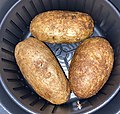 Baked Potatoes Cooked in an Air Fryer
 -
 Baked Potato
 -
 Baked Potato
 -
 Big Baked Potato Comic Postcard
 -
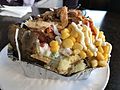 Kumpir - Turkish Cuisine


Medical Disclaimer: WikiMD is for informational purposes only and is not a substitute for professional medical advice. Content may be inaccurate or outdated and should not be used for diagnosis or treatment. Always consult your healthcare provider for medical decisions. Verify information with trusted sources such as CDC.gov and NIH.gov. By using this site, you agree that WikiMD is not liable for any outcomes related to its content. See full disclaimer.
Credits:Most images are courtesy of Wikimedia commons, and templates, categories Wikipedia, licensed under CC BY SA or similar.
Translate this page: - East Asian
中文,
日本,
한국어,
South Asian
हिन्दी,
தமிழ்,
తెలుగు,
Urdu,
ಕನ್ನಡ,
Southeast Asian
Indonesian,
Vietnamese,
Thai,
မြန်မာဘာသာ,
বাংলা
European
español,
Deutsch,
français,
Greek,
português do Brasil,
polski,
română,
русский,
Nederlands,
norsk,
svenska,
suomi,
Italian
Middle Eastern & African
عربى,
Turkish,
Persian,
Hebrew,
Afrikaans,
isiZulu,
Kiswahili,
Other
Bulgarian,
Hungarian,
Czech,
Swedish,
മലയാളം,
मराठी,
ਪੰਜਾਬੀ,
ગુજરાતી,
Portuguese,
Ukrainian
