Bacillus subtilis
Bacillus subtilis, also known as the hay bacillus or grass bacillus, is a Gram-positive, catalase-positive bacterium, found in soil and the gastrointestinal tract of ruminants and humans. A member of the genus Bacillus, B. subtilis is rod-shaped, and can form a tough, protective endospore, allowing it to tolerate extreme environmental conditions.
Classification[edit]
Bacillus subtilis is a member of the Bacillus genus of the Firmicutes phylum in the Bacteria domain. The species was originally classified in 1835 by Christian Gottfried Ehrenberg, and its name is Latin for "subtle".
Characteristics[edit]
Bacillus subtilis is a Gram-positive bacterium, meaning it has a thick peptidoglycan layer and no outer membrane. It is catalase-positive, and can form a tough, protective endospore, allowing it to tolerate extreme environmental conditions. B. subtilis has proven highly adaptable to harsh environments, and is not considered a human pathogen.
Research and uses[edit]
Bacillus subtilis is widely used in biotechnology and genetics research due to its ability to secrete large amounts of enzymes. It is also used in the fermentation of soybean products and as a soil inoculant in horticulture. In medicine, B. subtilis is used as a probiotic in the treatment of gastrointestinal disorders.
See also[edit]
References[edit]
 | This bacteria-related article is a stub. You can help WikiMD by expanding the page. |
Bacillus_subtilis[edit]
-
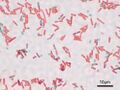
 Bacillus subtilis
 -
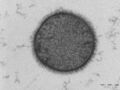
 Bacillus subtilis Spore
 -
Bacillus subtilis Endospore Stain
-
B. subtilis Sporulation Regulation
-
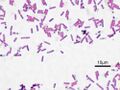 Bacillus subtilis Gram Stain
 -
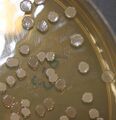 Bacillus subtilis Colonies


Medical Disclaimer: WikiMD is for informational purposes only and is not a substitute for professional medical advice. Content may be inaccurate or outdated and should not be used for diagnosis or treatment. Always consult your healthcare provider for medical decisions. Verify information with trusted sources such as CDC.gov and NIH.gov. By using this site, you agree that WikiMD is not liable for any outcomes related to its content. See full disclaimer.
Credits:Most images are courtesy of Wikimedia commons, and templates, categories Wikipedia, licensed under CC BY SA or similar.
Translate page: - East Asian
中文,
日本,
한국어,
South Asian
हिन्दी,
தமிழ்,
తెలుగు,
Urdu,
ಕನ್ನಡ,
Southeast Asian
Indonesian,
Vietnamese,
Thai,
မြန်မာဘာသာ,
বাংলা
European
español,
Deutsch,
français,
Greek,
português do Brasil,
polski,
română,
русский,
Nederlands,
norsk,
svenska,
suomi,
Italian
Middle Eastern & African
عربى,
Turkish,
Persian,
Hebrew,
Afrikaans,
isiZulu,
Kiswahili,
Other
Bulgarian,
Hungarian,
Czech,
Swedish,
മലയാളം,
मराठी,
ਪੰਜਾਬੀ,
ગુજરાતી,
Portuguese,
Ukrainian


