August Bier
August Bier (1861–1949) was a German surgeon and the pioneer of spinal anesthesia and intravenous therapy. He is also known for introducing the concept of Bier's block, a method of anesthesia used in the field of medicine.
Early Life and Education[edit]
Bier was born on November 24, 1861, in the town of Bad Arolsen, Germany. He studied medicine at the University of Leipzig and later at the University of Berlin, where he received his doctorate in 1886.
Career[edit]
After completing his studies, Bier worked as an assistant to Bernhard von Langenbeck, a renowned German surgeon. In 1891, he was appointed as the head of the surgical department at the University of Greifswald. He later served as a professor of surgery at the University of Kiel and the University of Berlin.
Bier made significant contributions to the field of anesthesia. In 1898, he performed the first operation using spinal anesthesia. He also developed the technique of intravenous therapy and introduced the concept of Bier's block, a method of anesthesia that involves the injection of a local anesthetic into a vein to numb a specific area of the body.
Legacy[edit]
Bier's work has had a profound impact on the field of medicine. His techniques of spinal anesthesia and intravenous therapy are still widely used today. The Bier's block method of anesthesia he developed is also commonly used in minor surgical procedures.
See Also[edit]
 | This medical article is a stub. You can help WikiMD by expanding the page. |
-
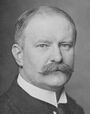 August Bier
 -
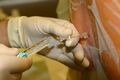 Liquor bei Spinalanästhesie
 -
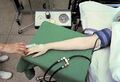 Venadaxili regional anesteziya


Medical Disclaimer: WikiMD is for informational purposes only and is not a substitute for professional medical advice. Content may be inaccurate or outdated and should not be used for diagnosis or treatment. Always consult your healthcare provider for medical decisions. Verify information with trusted sources such as CDC.gov and NIH.gov. By using this site, you agree that WikiMD is not liable for any outcomes related to its content. See full disclaimer.
Credits:Most images are courtesy of Wikimedia commons, and templates, categories Wikipedia, licensed under CC BY SA or similar.
Translate page: - East Asian
中文,
日本,
한국어,
South Asian
हिन्दी,
தமிழ்,
తెలుగు,
Urdu,
ಕನ್ನಡ,
Southeast Asian
Indonesian,
Vietnamese,
Thai,
မြန်မာဘာသာ,
বাংলা
European
español,
Deutsch,
français,
Greek,
português do Brasil,
polski,
română,
русский,
Nederlands,
norsk,
svenska,
suomi,
Italian
Middle Eastern & African
عربى,
Turkish,
Persian,
Hebrew,
Afrikaans,
isiZulu,
Kiswahili,
Other
Bulgarian,
Hungarian,
Czech,
Swedish,
മലയാളം,
मराठी,
ਪੰਜਾਬੀ,
ગુજરાતી,
Portuguese,
Ukrainian

