Atlantic jackknife clam
The Atlantic Jackknife Clam (Ensis leei), also known as the American Jackknife Clam or Razor Clam, is a large species of bivalve mollusk found along the Atlantic coast of North America.
Description[edit]
The Atlantic Jackknife Clam has a long, narrow shell that can reach up to 25 cm in length. The shell is thin and brittle, with a sharp edge, hence the name "jackknife". The color of the shell ranges from white to light brown, often with darker streaks or bands.
Habitat and Distribution[edit]
The Atlantic Jackknife Clam is found from the Gulf of St. Lawrence in Canada to North Carolina in the United States. It inhabits sandy and muddy bottoms in intertidal and subtidal zones, often burrowing to depths of up to 30 cm.
Life Cycle[edit]
The life cycle of the Atlantic Jackknife Clam begins with the release of eggs and sperm into the water column. After fertilization, the resulting larvae float in the water column for several weeks before settling onto the seafloor and metamorphosing into juvenile clams. The clams reach sexual maturity in one to two years.
Human Use[edit]
The Atlantic Jackknife Clam is harvested commercially and recreationally for its meat, which is considered a delicacy. It is often used in clam chowder and other seafood dishes.
Conservation Status[edit]
The Atlantic Jackknife Clam is not currently listed as threatened or endangered. However, overharvesting and habitat degradation pose potential threats to its populations.
See Also[edit]
References[edit]
 | This bivalve-related article is a stub. You can help WikiMD by expanding the page. |

-
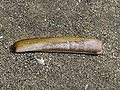 Atlantic jackknife clam on a sandy beach
 -
 Close-up of an Atlantic jackknife clam shell
 -
 Atlantic jackknife clam in its natural habitat


Medical Disclaimer: WikiMD is for informational purposes only and is not a substitute for professional medical advice. Content may be inaccurate or outdated and should not be used for diagnosis or treatment. Always consult your healthcare provider for medical decisions. Verify information with trusted sources such as CDC.gov and NIH.gov. By using this site, you agree that WikiMD is not liable for any outcomes related to its content. See full disclaimer.
Credits:Most images are courtesy of Wikimedia commons, and templates, categories Wikipedia, licensed under CC BY SA or similar.
Translate page: - East Asian
中文,
日本,
한국어,
South Asian
हिन्दी,
தமிழ்,
తెలుగు,
Urdu,
ಕನ್ನಡ,
Southeast Asian
Indonesian,
Vietnamese,
Thai,
မြန်မာဘာသာ,
বাংলা
European
español,
Deutsch,
français,
Greek,
português do Brasil,
polski,
română,
русский,
Nederlands,
norsk,
svenska,
suomi,
Italian
Middle Eastern & African
عربى,
Turkish,
Persian,
Hebrew,
Afrikaans,
isiZulu,
Kiswahili,
Other
Bulgarian,
Hungarian,
Czech,
Swedish,
മലയാളം,
मराठी,
ਪੰਜਾਬੀ,
ગુજરાતી,
Portuguese,
Ukrainian

