Aspergillus niger
Aspergillus niger is a fungus and one of the most common species of the genus Aspergillus. It causes a disease called "black mold" on certain fruits and vegetables such as grapes, onions, and peanuts, and is a common contaminant of food. It is ubiquitous in soil and is commonly reported from indoor environments, where its black colonies can be confused with those of Stachybotrys (species of which have also been called "black mold").
Characteristics[edit]
Aspergillus niger is a haploid fungus and grows by elongation of the hyphae and forms a mycelium. It is differentiated from other aspergilli by its black conidial heads. The conidia, which are the asexual spores of the fungus, are formed in long chains from the tips of the phialides, with the youngest spore at the base of the chain, and the oldest and first formed spore at the tip of the chain.
Pathogenicity[edit]
While Aspergillus niger is less likely to cause human disease than some other Aspergillus species, it has been known to infect the lungs of immunocompromised individuals, and is a common cause of otomycosis (fungal ear infections). In rare instances, it can cause aspergillosis in the lungs of individuals with a weakened immune system.
Industrial uses[edit]
Aspergillus niger is one of the most important industrial microorganisms. It has been in use for over a century and its industrial exploitation has been important to the development of biotechnology. It is used in the production of citric acid, gluconic acid, and many enzymes. It is also used in waste management and biotransformations.
See also[edit]

-
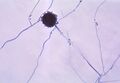 Aspergillus niger under a microscope
 -
Scanning electron micrograph of Aspergillus niger
-
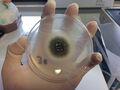 Aspergillus niger colony
 -
Aspergillus niger growing on onion
-
Aspergillus niger on MEA ox
-
Aspergillus niger melanoliber


Medical Disclaimer: WikiMD is for informational purposes only and is not a substitute for professional medical advice. Content may be inaccurate or outdated and should not be used for diagnosis or treatment. Always consult your healthcare provider for medical decisions. Verify information with trusted sources such as CDC.gov and NIH.gov. By using this site, you agree that WikiMD is not liable for any outcomes related to its content. See full disclaimer.
Credits:Most images are courtesy of Wikimedia commons, and templates, categories Wikipedia, licensed under CC BY SA or similar.
Translate page: - East Asian
中文,
日本,
한국어,
South Asian
हिन्दी,
தமிழ்,
తెలుగు,
Urdu,
ಕನ್ನಡ,
Southeast Asian
Indonesian,
Vietnamese,
Thai,
မြန်မာဘာသာ,
বাংলা
European
español,
Deutsch,
français,
Greek,
português do Brasil,
polski,
română,
русский,
Nederlands,
norsk,
svenska,
suomi,
Italian
Middle Eastern & African
عربى,
Turkish,
Persian,
Hebrew,
Afrikaans,
isiZulu,
Kiswahili,
Other
Bulgarian,
Hungarian,
Czech,
Swedish,
മലയാളം,
मराठी,
ਪੰਜਾਬੀ,
ગુજરાતી,
Portuguese,
Ukrainian


