Coronary circulation
Coronary circulation refers to the movement of blood through the arteries, veins, and capillaries that supply oxygen-rich blood to the heart muscle (myocardium). This circulatory system is crucial for maintaining the heart's function and overall health. The heart requires a continuous supply of oxygen and nutrients to perform its vital function of pumping blood throughout the body. The coronary circulation system ensures that the heart receives this essential support.
Anatomy of Coronary Circulation[edit]
The coronary circulation system consists of two main coronary arteries that branch off from the aorta just above the aortic valve. These are the left coronary artery (LCA) and the right coronary artery (RCA). Each of these arteries further divides into smaller branches that penetrate the heart muscle, providing oxygenated blood to the myocardium.
Left Coronary Artery (LCA)[edit]
The LCA starts as a single vessel, the left main coronary artery, which then bifurcates into two primary branches:
- The left anterior descending artery (LAD), which supplies blood to the front and bottom of the left ventricle and the front of the septum.
- The circumflex artery (Cx), which supplies blood to the left atrium, side and back of the left ventricle.
Right Coronary Artery (RCA)[edit]
The RCA supplies blood to the right atrium, the right ventricle, the bottom portion of both ventricles, and the back of the septum. It has several branches, including:
- The sinus node artery (SNA), which supplies blood to the sinoatrial node, responsible for the heart's rhythm.
- The right marginal artery and the posterior descending artery (PDA), which supply the right ventricle and the bottom and back of the left ventricle, respectively.
Physiology of Coronary Circulation[edit]
The coronary arteries fill during the heart's relaxation phase, known as diastole. The high pressure in the aorta helps to push blood into the coronary vessels. The oxygen-rich blood travels through the coronary arteries and permeates the heart muscle via a network of capillaries, where oxygen and nutrients are exchanged for carbon dioxide and waste products. The deoxygenated blood is then collected by the coronary veins, which converge into the coronary sinus, and is eventually returned to the right atrium.
Clinical Significance[edit]
Coronary circulation disorders, such as coronary artery disease (CAD), can lead to significant health issues, including heart attack, angina pectoris, and heart failure. CAD occurs when the coronary arteries become narrowed or blocked by plaque buildup, a condition known as atherosclerosis. This can reduce blood flow to the heart muscle, causing chest pain (angina) or a heart attack.
Diagnosis and Treatment[edit]
Diagnosis of coronary circulation issues often involves imaging tests such as coronary angiography, CT coronary angiogram, and stress tests. Treatment may include lifestyle changes, medications, and procedures like angioplasty and coronary artery bypass grafting (CABG) to restore blood flow to the heart muscle.
Conclusion[edit]
Coronary circulation is a vital component of cardiovascular health, ensuring the heart muscle receives the necessary oxygen and nutrients to function effectively. Understanding the anatomy and physiology of coronary circulation helps in the diagnosis and treatment of coronary artery diseases, ultimately contributing to better heart health outcomes.
-
Surface anatomy of the heart
-
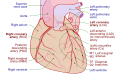 Diagram of coronary arteries
 -
Diagram of cardiac vessels
-
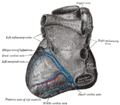 Gray's anatomy illustration of coronary circulation
 -
Coronary arteries
-
 Anterior view of coronary vessels
 -
 Posterior view of coronary vessels
 -
Coronary arteries


Medical Disclaimer: WikiMD is for informational purposes only and is not a substitute for professional medical advice. Content may be inaccurate or outdated and should not be used for diagnosis or treatment. Always consult your healthcare provider for medical decisions. Verify information with trusted sources such as CDC.gov and NIH.gov. By using this site, you agree that WikiMD is not liable for any outcomes related to its content. See full disclaimer.
Credits:Most images are courtesy of Wikimedia commons, and templates, categories Wikipedia, licensed under CC BY SA or similar.
Translate this page: - East Asian
中文,
日本,
한국어,
South Asian
हिन्दी,
தமிழ்,
తెలుగు,
Urdu,
ಕನ್ನಡ,
Southeast Asian
Indonesian,
Vietnamese,
Thai,
မြန်မာဘာသာ,
বাংলা
European
español,
Deutsch,
français,
Greek,
português do Brasil,
polski,
română,
русский,
Nederlands,
norsk,
svenska,
suomi,
Italian
Middle Eastern & African
عربى,
Turkish,
Persian,
Hebrew,
Afrikaans,
isiZulu,
Kiswahili,
Other
Bulgarian,
Hungarian,
Czech,
Swedish,
മലയാളം,
मराठी,
ਪੰਜਾਬੀ,
ગુજરાતી,
Portuguese,
Ukrainian


