Army engineer diver
Apparent viscosity is a measure of a fluid's resistance to flow under specific conditions. Unlike true viscosity, which is a constant property of a fluid, apparent viscosity can vary depending on the shear rate or shear stress applied to the fluid. This property is particularly important in the study of non-Newtonian fluids, where the viscosity is not constant but changes with the rate of shear.
Definition[edit]
Apparent viscosity is defined as the ratio of shear stress to shear rate in a fluid. It is expressed mathematically as:
- \( \eta_{app} = \frac{\tau}{\dot{\gamma}} \)
where \( \eta_{app} \) is the apparent viscosity, \( \tau \) is the shear stress, and \( \dot{\gamma} \) is the shear rate. This relationship indicates that apparent viscosity is dependent on the conditions under which it is measured.
Non-Newtonian Fluids[edit]
Non-Newtonian fluids are fluids whose viscosity changes with the applied shear rate. These fluids do not have a constant viscosity and are characterized by their apparent viscosity. Examples include:
- Shear-thinning fluids, such as ketchup, which become less viscous as the shear rate increases.
- Shear-thickening fluids, such as cornstarch in water, which become more viscous as the shear rate increases.
- Thixotropic fluids, which decrease in viscosity over time under constant shear.
- Rheopectic fluids, which increase in viscosity over time under constant shear.
Measurement[edit]
Apparent viscosity is typically measured using a rheometer or a viscometer. These instruments apply a controlled shear rate or shear stress to the fluid and measure the resulting flow behavior. The choice of instrument and measurement technique depends on the type of fluid and the range of shear rates of interest.
Applications[edit]
Understanding apparent viscosity is crucial in various industries, including:
- Food industry: For the processing and quality control of products like sauces and dressings.
- Pharmaceutical industry: In the formulation of creams and gels.
- Petroleum industry: For the characterization of drilling muds and crude oils.
- Paints and coatings: To ensure proper application and finish.
Factors Affecting Apparent Viscosity[edit]
Several factors can influence the apparent viscosity of a fluid, including:
- Temperature: Viscosity generally decreases with increasing temperature.
- Pressure: Higher pressures can increase viscosity.
- Composition: The presence of additives or impurities can alter viscosity.
- Time: For time-dependent fluids, the duration of applied shear can affect viscosity.
Related pages[edit]
Gallery[edit]
-
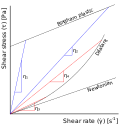 Illustration of apparent viscosity

Medical Disclaimer: WikiMD is for informational purposes only and is not a substitute for professional medical advice. Content may be inaccurate or outdated and should not be used for diagnosis or treatment. Always consult your healthcare provider for medical decisions. Verify information with trusted sources such as CDC.gov and NIH.gov. By using this site, you agree that WikiMD is not liable for any outcomes related to its content. See full disclaimer.
Credits:Most images are courtesy of Wikimedia commons, and templates, categories Wikipedia, licensed under CC BY SA or similar.
Translate this page: - East Asian
中文,
日本,
한국어,
South Asian
हिन्दी,
தமிழ்,
తెలుగు,
Urdu,
ಕನ್ನಡ,
Southeast Asian
Indonesian,
Vietnamese,
Thai,
မြန်မာဘာသာ,
বাংলা
European
español,
Deutsch,
français,
Greek,
português do Brasil,
polski,
română,
русский,
Nederlands,
norsk,
svenska,
suomi,
Italian
Middle Eastern & African
عربى,
Turkish,
Persian,
Hebrew,
Afrikaans,
isiZulu,
Kiswahili,
Other
Bulgarian,
Hungarian,
Czech,
Swedish,
മലയാളം,
मराठी,
ਪੰਜਾਬੀ,
ગુજરાતી,
Portuguese,
Ukrainian
