Arctic fox
-
 Arctic fox in Iceland
 -
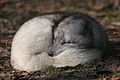 Arctic fox in winter coat
 -
 Arctic fox pups
 -
 Arctic fox with fish
 -
 Arctic fox lying in grass
 -
 Blue fox on St. Paul Island
 -
 Arctic foxes
 -
 Arctic fox skull
 -
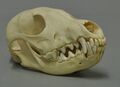 Arctic fox specimen
.jpg)


Arctic Fox[edit]
The Arctic fox (Vulpes lagopus), also known as the white fox, polar fox, or snow fox, is a small fox native to the Arctic regions of the Northern Hemisphere. It is well adapted to living in cold environments and is best known for its thick, warm fur that is also used as camouflage.
Description[edit]
The Arctic fox is a small fox, measuring 46 to 68 cm in body length, with a generally rounded body shape to minimize the escape of body heat. It has a bushy tail, short ears, and a short muzzle. The fur of the Arctic fox is dense and warm, providing excellent insulation against the cold. In the winter, the fur is white, which helps the fox blend in with the snow and ice. In the summer, the fur changes to a brown or gray color, which provides camouflage against the tundra's summer landscape.
Habitat[edit]
The Arctic fox inhabits the tundra regions of the Arctic, including Alaska, Canada, Greenland, Iceland, Norway, Sweden, and Russia. It is well adapted to the cold, with a thick coat and a high-fat diet that helps it survive in temperatures as low as -50°C.
Diet[edit]
The Arctic fox is an omnivore, with a diet that varies seasonally. In the winter, it primarily preys on lemmings, voles, and other small mammals. It is also known to scavenge on carrion left by larger predators such as the polar bear. In the summer, the Arctic fox's diet expands to include birds, eggs, insects, and berries.
Reproduction[edit]
Arctic foxes are monogamous and form pairs during the breeding season. The breeding season occurs in the spring, and after a gestation period of about 52 days, the female gives birth to a litter of 5 to 10 pups. The pups are born in a den, which is often a complex burrow system that provides protection from predators and harsh weather.
Adaptations[edit]
The Arctic fox has several adaptations that allow it to survive in its harsh environment. Its thick fur provides insulation, while its compact body shape reduces heat loss. The fox's paws are covered in fur, which provides traction on ice and snow and helps to keep its feet warm. Additionally, the Arctic fox has a keen sense of hearing, which it uses to locate prey under the snow.
Conservation Status[edit]
The Arctic fox is classified as Least Concern by the International Union for Conservation of Nature (IUCN), although some populations are threatened by habitat loss and climate change. In some regions, the Arctic fox is also threatened by competition with the red fox, which is expanding its range northward as temperatures rise.
Related Pages[edit]
| Arctic | ||||||||||
|---|---|---|---|---|---|---|---|---|---|---|
|

Medical Disclaimer: WikiMD is for informational purposes only and is not a substitute for professional medical advice. Content may be inaccurate or outdated and should not be used for diagnosis or treatment. Always consult your healthcare provider for medical decisions. Verify information with trusted sources such as CDC.gov and NIH.gov. By using this site, you agree that WikiMD is not liable for any outcomes related to its content. See full disclaimer.
Credits:Most images are courtesy of Wikimedia commons, and templates, categories Wikipedia, licensed under CC BY SA or similar.
Translate page: - East Asian
中文,
日本,
한국어,
South Asian
हिन्दी,
தமிழ்,
తెలుగు,
Urdu,
ಕನ್ನಡ,
Southeast Asian
Indonesian,
Vietnamese,
Thai,
မြန်မာဘာသာ,
বাংলা
European
español,
Deutsch,
français,
Greek,
português do Brasil,
polski,
română,
русский,
Nederlands,
norsk,
svenska,
suomi,
Italian
Middle Eastern & African
عربى,
Turkish,
Persian,
Hebrew,
Afrikaans,
isiZulu,
Kiswahili,
Other
Bulgarian,
Hungarian,
Czech,
Swedish,
മലയാളം,
मराठी,
ਪੰਜਾਬੀ,
ગુજરાતી,
Portuguese,
Ukrainian

